To be sold on retail on prescription of a Registered Medical Practitioner only.
Prescribing Information
1.0 Generic Name
Amoxycillin and Potassium Clavulanate for Oral Suspension IP
2.0 Qualitative and Quantitative Composition
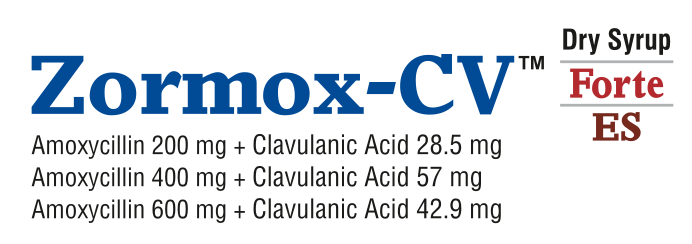
Zormox CV Dry Syrup Each combipack contains (A) Amoxycillin and Potassium Clavulanate for Oral Suspension IP Each 5 ml of reconstituted suspension contains : Amoxycillin Trihydrate IP eq. to Amoxycillin……………………………200 mg Potassium Clavulanate Diluted IP eq. to Clavulanic Acid………………………………………………………. 28.5 mg (B) 1 Vial of Sterile Water for Reconstitution 30 ml
Zormox CV Forte Dry Syrup Each combipack contains (A) Amoxycillin and Potassium Clavulanate for Oral Suspension IP Each 5 ml of reconstituted suspension contains : Amoxycillin Trihydrate IP eq. to Amoxycillin……………………………400 mg Potassium Clavulanate Diluted IP eq. to Clavulanic Acid………………………………………………………. 57 mg (B) 1 Vial of Sterile Water for Reconstitution 30 ml
3.0 Dosage Form and Strength
Dry powder for oral suspension Amoxycillin and Potassium Clavulanate (200 mg/400 mg and 28.5mg/57 mg)
4.0 Clinical Particulars
4.1 Therapeutic Indications
For the treatment of bacterial infections such as sinusitis, otitis media, tonsillitis, acute and chronic bronchitis, skin and soft tissue infections and post-operative pain.
4.2 Posology and Method of Administration
Posology Dosage depends on the age, weight and renal function of the patient and the severity of the infection. Dosages are expressed throughout in terms of amoxycillin/clavulanate content except when doses are stated in terms of an individual component. To minimise potential gastrointestinal intolerance, administer at the start of a meal. The absorption of Amoxycillin & Potassium clavulanate is optimised when taken at the start of a meal. Treatment should not exceed 14 days without review. Therapy can be started parenterally and continued with an oral preparation. The usual recommended daily dosage is: • 25/3.6 mg/kg/day in mild to moderate infections (upper respiratory tract infections e.g. recurrent tonsillitis, lower respiratory infections and skin and soft tissue infections) • 45/6.4 mg/kg/day for the treatment of more serious infections (upper respiratory tract infections e.g. otitis media and sinusitis, lower respiratory tract infections e.g. bronchopneumonia and urinary tract infections). No clinical data are available on doses above 45/6.4 mg/kg/day in children under 2 years. The tables below give guidance for children:
Children Aged Over 2 Years
2 to 6 years (13–21 kg)
7 - 12 years (22 - 40 kg)
25/3.6 mg/kg/day
2.5 mL twice daily
5 mL twice daily
45/6.4 mg/kg/day
5 mL twice daily
10 ml twice daily
Children aged below 2 years should be dosed according to body weight
Body Weight (kg)
Lower dose at 25/3.6 mg/kg/day (mL every 12 hours)
Higher dose at 45/6.4 mg/kg/day (mL every 12 hours)
2
0.3
0.6
3
0.5
0.8
4
0.6
1.1
5
0.8
1.4
6
0.9
1.7
7
1.1
2.0
8
1.3
2.3
9
1.4
2.5
10
1.6
2.8
11
1.7
3.1
12
1.9
3.4
13
2.0
3.7
14
2.2
3.9
15
2.3
4.2
Renal Impairment No adjustment in dose is required in patients with creatinine clearance greater than 30 mL/min. Amoxycillin & Potassium clavulanate suspension 457 mg/5 mL is not recommended in patients with a creatinine clearance of less than 30 mL/min.
Hepatic Impairment Dose with caution; monitor hepatic function at regular intervals. There is, as yet, insufficient evidence on which to base a dosage recommendation.
Method of administration: For oral administration only. To minimize potential gastrointestinal intolerance, administer at the start of a meal. The absorption of Amoxycillin/clavulanic acid is optimized when taken at the start of a meal. Duration of therapy should be appropriate to the indication and should not exceed 14 days without review. Therapy can be started parenterally and continued with an oral preparation.
Instructions for Use/Handling: At the time of dispensing, the dry powder should be reconstituted to form an oral suspension. First shake the bottle to loosen the powder. Add Sterile Water (given with the pack) to two-thirds of the fill mark on the bottle. Replace the cap, and shake the bottle until all of the powder is suspended. Add more water until the level of the fill line is attained, and shake again. When first reconstituted, allow to stand for 5 minutes to ensure full dispersion. After reconstitution, keep in the refrigerator when not in use. Use the reconstituted syrup within 7 days. Shake the bottle before each dose.
4.3 Contraindications
Amoxycillin & Potassium clavulanate is contraindicated in patients with a history of serious hypersensitivity reactions (e.g. anaphylaxis or Stevens-Johnson syndrome) to amoxycillin, clavulanate or to other beta-lactam antibacterial drugs (e.g. penicillins and cephalosporins).
Amoxycillin & Potassium clavulanate oral suspension is contraindicated in patients with a previous history of cholestatic jaundice/hepatic dysfunction associated with amoxycillin/clavulanic acid.
4.4 Special Warnings and Precautions for use
Hypersensitivity Reactions Serious, and occasionally fatal, hypersensitivity (anaphylactic) reactions have been reported in patients receiving beta-lactam antibacterials, including amoxycillin/clavulanic acid. These reactions are more likely to occur in individuals with a history of penicillin hypersensitivity and/or a history of sensitivity to multiple allergens. Before initiating therapy with amoxycillin/clavulanic acid, careful inquiry should be made regarding previous hypersensitivity reactions to penicillins, cephalosporins, or other allergens. If an allergic reaction occurs, amoxycillin/clavulanic acid should be discontinued and appropriate therapy instituted.
Hepatic Dysfunction Hepatic dysfunction, including hepatitis and cholestatic jaundice, has been associated with the use of amoxycillin/clavulanic acid. Hepatic toxicity is usually reversible; however, deaths have been reported. Hepatic function should be monitored at regular intervals in patients with hepatic impairment.
Clostridium difficile Associated Diarrhoea (CDAD) Clostridium difficile-associated diarrhoea (CDAD) has been reported with the use of nearly all antibacterial agents, including amoxycillin/clavulanic acid, and may range in severity from mild diarrhoea to fatal colitis. Treatment with antibacterial agents alters the normal flora of the colon, leading to overgrowth of C. difficile. C. difficile produces toxins A and B, which contribute to the development of CDAD. Hypertoxin-producing strains of C. difficile cause increased morbidity and mortality, as these infections can be refractory to antimicrobial therapy and may require a colectomy. CDAD must be considered in all patients who present with diarrhoea following antibacterial use. Careful medical history is necessary since CDAD has been reported to occur over 2 months after the administration of antibacterial agents. If CDAD is suspected or confirmed, ongoing antibacterial use not directed against C. difficile may need to be discontinued. Appropriate fluid and electrolyte management, protein supplementation, antibacterial treatment of C. difficile, and surgical evaluation should be instituted as clinically indicated.
Potential for Microbial Overgrowth The possibility of superinfections with fungal or bacterial pathogens should be considered during therapy. If superinfection occurs, amoxycillin/clavulanate potassium should be discontinued and appropriate therapy instituted.
Development of Drug-Resistant Bacteria Prescribing amoxycillin/clavulanic acid in the absence of a proven or strongly suspected bacterial infection is unlikely to provide benefit to the patient, and increases the risk of the development of drug-resistant bacteria.
Skin Rash in Patients with Mononucleosis A high percentage of patients with mononucleosis who receive amoxycillin develop an erythematous skin rash. Thus, amoxycillin/clavulanic acid should not be administered to patients with mononucleosis.
Others Convulsions may occur in patients with impaired renal function or in those receiving high doses. Amoxycillin/clavulanic acid should be avoided if infectious mononucleosis is suspected since the occurrence of a morbilliform rash has been associated with this condition following the use of amoxycillin. Concomitant use of allopurinol during treatment with amoxycillin can increase the likelihood of allergic skin reactions. The occurrence at the treatment initiation of a feverish generalised erythema associated with pustula may be a symptom of acute generalised exanthematous pustulosis (AGEP). This reaction requires Amoxycillin/Clavulanic acid discontinuation and contraindicates any subsequent administration of amoxycillin. Periodic assessment of organ system functions; including renal, hepatic and haematopoietic function is advisable during prolonged therapy. Prolongation of prothrombin time has been reported rarely in patients receiving amoxycillin/clavulanic acid. Appropriate monitoring should be undertaken when anticoagulants are prescribed concomitantly. Adjustments in the dose of oral anticoagulants may be necessary to maintain the desired level of anticoagulation. In patients with reduced urine output, crystalluria has been observed very rarely, predominantly with parenteral therapy. During the administration of high doses of amoxycillin, it is advisable to maintain adequate fluid intake and urinary output in order to reduce the possibility of amoxycillin crystalluria. In patients with bladder catheters, a regular check of patency should be maintained. During treatment with amoxycillin, enzymatic glucose oxidase methods should be used whenever testing for the presence of glucose in urine because false positive results may occur with non-enzymatic methods.
4.5 Drug Interactions
Probenecid Probenecid decreases the renal tubular secretion of amoxycillin but does not delay renal excretion of clavulanic acid. Concurrent use with Amoxycillin/Clavulanic acid may result in increased and prolonged blood concentrations of amoxycillin. Co-administration of probenecid is not recommended.
Oral anticoagulants Oral anticoagulants and penicillin antibiotics have been widely used in practice without reports of interaction. However, in the literature there are cases of increased international normalised ratio in patients maintained on acenocoumarol or warfarin and prescribed a course of amoxycillin. If co-administration is necessary, the prothrombin time or international normalised ratio should be carefully monitored with the addition or withdrawal of amoxycillin. Moreover, adjustments in the dose of oral anticoagulants may be necessary.
Methotrexate Penicillins may reduce the excretion of methotrexate causing a potential increase in toxicity.
Mycophenolate mofetil In patients receiving mycophenolate mofetil, reduction in pre-dose concentration of the active metabolite mycophenolic acid (MPA) of approximately 50% has been reported following commencement of oral amoxycillin plus clavulanic acid. The change in pre-dose level may not accurately represent changes in overall MPA exposure. Therefore, a change in the dose of mycophenolate mofetil should not normally be necessary in the absence of clinical evidence of graft dysfunction. However, close clinical monitoring should be performed during the combination and shortly after antibiotic treatment.
Allopurinol The concurrent administration of allopurinol and amoxycillin increases the incidence of rashes in patients receiving both drugs as compared with patients receiving amoxycillin alone. It is not known whether this potentiation of amoxycillin rashes is due to allopurinol or the hyperuricaemia present in these patients.
Oral Contraceptives Amoxycillin/Clavulanic acid may affect intestinal flora, leading to lower oestrogen reabsorption and reduced efficacy of combined oral oestrogen/progesterone contraceptives.
Effects on Laboratory Tests High urine concentrations of amoxycillin may result in false-positive reactions when testing for the presence of glucose in urine using CLINITEST, Benedict's Solution, or Fehling's Solution. Since this effect may also occur with Amoxycillin/Clavulanic acid, it is recommended that glucose tests based on enzymatic glucose oxidase reactions be used. Following administration of amoxycillin to pregnant women, a transient decrease in plasma concentration of total conjugated oestriol, oestriol-glucuronide, conjugated oestrone, and oestradiol has been noted.
4.6 Use in Special Population
Pregnancy Pregnancy Category B. There are no adequate and well-controlled studies in pregnant women. Because animal reproduction studies are not always predictive of human response, this drug should be used during pregnancy only if clearly needed.
Lactation Amoxycillin has been shown to be excreted in human milk. Amoxycillin/clavulanate potassium use by nursing mothers may lead to sensitization of infants. Caution should be exercised when amoxycillin/clavulanate potassium is administered to a nursing mother.
Paediatric Use The safety and effectiveness of Amoxycillin/Clavulanic acid powder for oral suspension has been established in paediatric patients. Use of amoxycillin/clavulanic acid in paediatric patients is supported by evidence from studies of amoxycillin/clavulanic acid tablets in adults with additional data from a study of amoxycillin/clavulanic acid powder for oral suspension in paediatric patients aged 2 months to 12 years with acute otitis media. Because of incompletely developed renal function in neonates and young infants, the elimination of amoxycillin may be delayed; clavulanate elimination is unaltered in this age group. Dosing of amoxycillin/clavulanic acid should be modified in paediatric patients aged < 3 months.
Geriatric Use Of the 3,119 patients in an analysis of clinical studies of Amoxycillin/Clavulanic acid, 32% were ≥65 years old, and 14% were ≥75 years old. No overall differences in safety or effectiveness were observed between these subjects and younger subjects, and other reported clinical experience has not identified differences in responses between the elderly and younger patients, but the greater sensitivity of some older individuals cannot be ruled out. This drug is known to be substantially excreted by the kidneys, and the risk of adverse reactions to this drug may be greater in patients with impaired renal function. Because elderly patients are more likely to have decreased renal function, care should be taken in dose selection, and it may be useful to monitor renal function.
Dosing in Renal Impairment Amoxycillin is primarily eliminated by the kidneys and dosage adjustment is usually required in patients with severe renal impairment.
4.7 Effects on Ability to Drive and Use Machines
No studies on the effects on the ability to drive and use machines have been performed. However, undesirable effects may occur (e.g. allergic reactions, dizziness, convulsions), which may influence the ability to drive and use machines.
Clinical Trial Experience The most frequently reported adverse reactions were diarrhoea/loose stools (9%), nausea (3%), skin rashes and urticaria (3%), vomiting (1%), and vaginitis (1%). Less than 3% of patients discontinued therapy because of drug related adverse reactions. The overall incidence of adverse reactions and, in particular, diarrhoea, increased with the higher recommended dose. Other less frequently reported adverse reactions (<1%) included abdominal discomfort, flatulence, and headache.
Post-marketing Experience Gastrointestinal: Indigestion, gastritis, stomatitis, glossitis, black 'hairy' tongue, mucocutaneous candidiasis, enterocolitis, and haemorrhagic/pseudomembranous colitis. Hypersensitivity Reactions: Pruritus, angio-oedema, serum sickness-like reactions, erythema multiforme, Stevens-Johnson syndrome, acute generalized exanthematous pustulosis, hypersensitivity vasculitis, and cases of exfoliative dermatitis (including toxic epidermal necrosis). Liver: Hepatic dysfunction, including hepatitis and cholestatic jaundice, increases in serum transaminases (AST and/or ALT), serum bilirubin, and/or alkaline phosphatase. Renal: Interstitial nephritis, haematuria, and crystalluria. Haemic and Lymphatic Systems: Anaemia, including haemolytic anaemia, thrombocytopenia, thrombocytopenic purpura, eosinophilia, leucopenia, and agranulocytosis. Central Nervous System: Agitation, anxiety, behavioural changes, confusion, convulsions, dizziness, insomnia, and reversible hyperactivity. Miscellaneous: Tooth discolouration (brown, yellow, or grey staining) has been reported. Most reports occurred in paediatric patients. Discolouration was reduced or eliminated with brushing or dental cleaning in most cases.
Reporting of Suspected Adverse Reactions Reporting suspected adverse reactions after authorization of the medicinal product is important. It allows continued monitoring of the benefit/risk balance of the medicinal product. Healthcare professionals are asked to report any suspected adverse reactions via email to: medico@zorvia.com By reporting side effects, you can help provide more information on the safety of this medicine.
4.9 Overdose
In case of overdosage, discontinue medication, treat symptomatically, and institute supportive measures as required. A prospective study of 51 paediatric patients at a poison control centre suggested that overdosages of less than 250 mg/kg of amoxycillin are not associated with significant clinical symptoms. Interstitial nephritis resulting in oliguric renal failure has been reported in patients after overdosage with amoxycillin/clavulanate potassium. Crystalluria, in some cases leading to renal failure, has also been reported after amoxycillin/clavulanate potassium overdosage in adult and paediatric patients. In case of overdosage, adequate fluid intake and diuresis should be maintained to reduce the risk of amoxycillin/clavulanate potassium crystalluria. Renal impairment appears to be reversible with cessation of drug administration. High blood levels may occur more readily in patients with impaired renal function because of decreased renal clearance of amoxycillin/clavulanate potassium. Amoxycillin/clavulanate potassium may be removed from circulation by haemodialysis.
5.0 Pharmacological Properties
5.1 Mechanism of action / Pharmacodynamic properties
Pharmacotherapeutic group: Combinations of penicillins, incl. beta-lactamase inhibitors. Amoxycillin is a semisynthetic antibiotic with in vitro bactericidal activity against Gram-positive and gram-negative bacteria. Amoxycillin is, however, susceptible to degradation by beta-lactamases and, therefore, the spectrum of activity does not include organisms that produce these enzymes. Clavulanic acid is a beta-lactam structurally related to the penicillins, which possesses the ability to inactivate some beta-lactamase enzymes commonly found in microorganisms resistant to penicillins and cephalosporins. In particular, it has good activity against the clinically important plasmid-mediated beta-lactamases frequently responsible for transferred drug resistance. The formulation of amoxycillin and clavulanic acid, protects amoxycillin from degradation by some beta-lactamase enzymes and extends the antibiotic spectrum of amoxycillin to include many bacteria normally resistant to amoxycillin. Pharmacokinetic/pharmacodynamic relationship: The time above the minimum inhibitory concentration (T>MIC) is considered to be the major determinant of efficacy for amoxycillin.
5.2 Pharmacokinetic properties
Absorption Amoxycillin and clavulanic acid, are fully dissociated in aqueous solution at physiological pH. Both components are rapidly and well absorbed by the oral route of administration. Absorption of amoxycillin/clavulanic acid is optimised when taken at the start of a meal. Following oral administration, amoxycillin and clavulanic acid are approximately 70% bioavailable. The plasma profiles of both components are similar and the time to peak plasma concentration (Tmax) in each case is approximately one hour.
Distribution About 25% of total plasma clavulanic acid and 18% of total plasma amoxycillin is bound to protein. The apparent volume of distribution is around 0.3-0.4 l/kg for amoxycillin and around 0.2 l/kg for clavulanic acid. Following intravenous administration, both amoxycillin and clavulanic acid have been found in gall bladder, abdominal tissue, skin, fat, muscle tissues, synovial and peritoneal fluids, bile and pus. Amoxycillin does not adequately distribute into the cerebrospinal fluid. Both amoxycillin and clavulanic acid have been shown to cross the placental barrier.
Biotransformation Amoxycillin is partly excreted in the urine as the inactive penicilloic acid in quantities equivalent to up to 10 to 25% of the initial dose. Clavulanic acid is extensively metabolized in man and eliminated in urine and faeces and as carbon dioxide in expired air.
Elimination The major route of elimination for amoxycillin is via the kidney, whereas for clavulanic acid it is by both renal and non-renal mechanisms. Amoxycillin/clavulanic acid has a mean elimination half-life of approximately one hour and a mean total clearance of approximately 25 l/h in healthy subjects. Approximately 60 to 70% of the amoxycillin and approximately 40 to 65% of the clavulanic acid are excreted unchanged in urine during the first 6 h after administration of single Amoxycillin/clavulanic acid 400/57mg/5ml Powder for Oral Suspension, 250 mg/125 mg or 500 mg/125 mg tablets.
6.0 Nonclinical Properties
6.1 Animal Toxicology or Pharmacology
Non-clinical data reveal no special hazard for humans based on studies of safety pharmacology, genotoxicity and toxicity to reproduction. Repeat dose toxicity studies performed in dogs with Amoxycillin/Clavulanic Acid demonstrate gastric irritancy and vomiting, and discoloured tongue. Carcinogenicity studies have not been conducted with Amoxycillin/Clavulanic Acid.
7.0 Description
Zormox CV dry syrup/Zormox CV Forte dry syrup (beta-lactam antibacterial penicillin coformulated with a beta-lactamase inhibitor) is an antibiotic agent with a notably broad spectrum of activity against the commonly occurring bacterial pathogens in general practice and hospital. The beta-lactamase inhibitory action of clavulanate extends the spectrum of amoxycillin to embrace a wider range of organisms, including many resistant to other beta-lactam antibiotics.
8. Pharmaceutical particulars
8.1 Incompatibilities
Not applicable
8.2 Shelf-Life
Refer on pack
8.3 Packaging Information
Refer on pack
8.4 Storage and Handling Instructions
Store protected from moisture, at a temperature not exceeding 25°C. Keep all medicines out of reach of children.
9.0 Patient Counselling Information
Patients should be informed that Zormox CV syrup/Zormox CV Forte dry syrup may be taken every 8 hours or every 12 hours, depending on the dose prescribed. Each dose should be taken with a meal or snack to reduce the possibility of gastrointestinal upset. Patients should be counseled that antibacterial drugs, including Zormox CV syrup/Zormox CV Forte dry syrup, should only be used to treat bacterial infections. They do not treat viral infections (e.g., the common cold). When Zormox CV syrup/Zormox CV Forte dry syrup is prescribed to treat a bacterial infection, patients should be told that although it is common to feel better early in the course of therapy, the medication should be taken exactly as directed. Skipping doses or not completing the full course of therapy may : (1) decrease the effectiveness of the immediate treatment, and (2) increase the likelihood that bacteria will develop resistance and will not be treatable by Zormox CV syrup/Zormox CV Forte dry syrup or other antibacterial drugs in the future.
Counsel patients that diarrhea is a common problem caused by antibacterials, and it usually ends when the antibacterial is discontinued. Sometimes after starting treatment with antibacterials, patients can develop watery and bloody stools (with or without stomach cramps and fever) even as late as 2 or more months after having taken their last dose of the antibacterial. If diarrhea is severe or lasts more than 2 or 3 days, patients should contact their physician.
Patients should be aware that Zormox CV syrup/Zormox CV Forte dry syrup contains a penicillin class drug product that can cause allergic reactions in some individuals.