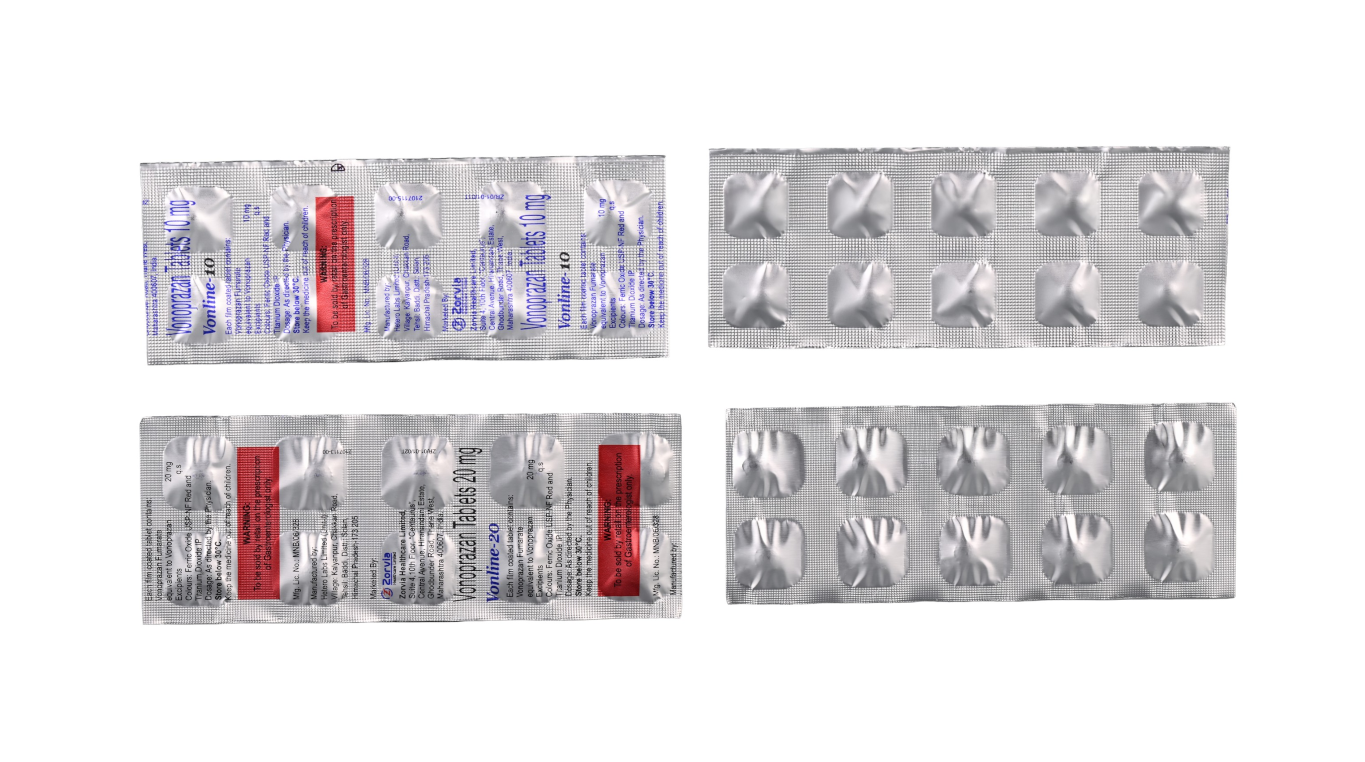
To be sold by retail on the prescription of Gastroenterologist only.
Prescribing Information
1.0 Generic Name
Vonoprazan Tablets 10mg/20mg
2.0 Qualitative and Quantitative Composition
Each film coated tablet contains: Vonoprazan Fumarate equivalent to Vonoprazan……20 mg Excipients …………………………………………………………. q.s.
3.0 Dosage Form and Strength
Tablets: 10 mg / 20 mg of Vonoprazan
4.0 Clinical Particulars
4.1 Therapeutic Indications
Treatment of reflux esophagitis (RE)
Treatment of gastric ulcer (GU)
Treatment of duodenal ulcer (DU)
Prevention of recurrence of gastric ulcer or duodenal ulcer during low dose aspirin administration.
Prevention of recurrence of gastric ulcer or duodenal ulcer during NSAIDs administration.
Adjunct to Helicobacter pylori eradication associated with: Gastric ulcer, Duodenal ulcer, gastric MALT lymphoma, idiopathic thrombocytopenic purpura, the stomach after endoscopic resection of early-stage cancer, or Helicobacter pylori gastritis.
4.2 Posology and Method of Administration
Dosage
Treatment of Reflux Esophagitis (RE):
The recommended oral dosage of Vonoprazan is 20 mg once daily for up to 8 weeks.
Maintenance of Healed Reflux Esophagitis:
The recommended oral dosage is 10 mg once daily for up to 6 months.
Gastric ulcer
The usual dose is 20 mg of Vonoprazan once a day. Administration should be limited to 8 weeks.
Duodenal ulcer
The usual dose is 20 mg of Vonoprazan once a day. Administration should be limited to 6 weeks.
Prevention of recurrence of gastric ulcer or duodenal ulcer during low-dose aspirin administration
The usual dose is 10 mg of Vonoprazan once a day up to 6 months.
Prevention of recurrence of gastric ulcer or duodenal ulcer during NSAIDs administration
The usual dose is 10 mg of Vonoprazan once a day up to 6 months.
Adjunct to Helicobacter pylori eradication
The recommended adult oral dosage is Vonoprazan 20 mg plus amoxicillin 1,000 mg plus clarithromycin 500 mg, each given twice daily (in the morning and evening, 12 hours apart) for 14 days.
When Helicobacter pylori eradication treatment with 3 drugs consisting of a proton pump inhibitor, amoxicillin hydrate, and clarithromycin fails, alternative treatment with the following 3 drugs is recommended; 20 mg Vonoprazan, 750 mg amoxicillin hydrate, and 250 mg metronidazole, orally administered at the same time twice daily for 7 days. The doses of antibiotic should follow the respective label recommendations for H. pylori eradication.
Recommended Dosage in Patients with Renal Impairment
Healing of Erosive Esophagitis
The recommended dosage of Vonoprazan in adult patients with renal impairment is described in Table 1 below
Table 1: Recommended Vonoprazan Dosage in Patients with Renal Impairment: Healing of Erosive Esophagitis
Estimated glomerular filtration rate (GFR)
Recommended Dosage
30 mL/minute or greater
20 mg once daily
Less than 30 mL/minute
10 mg once daily
Treatment of H. pylori Infection
The recommended dosage of Vonoprazan in adult patients with renal impairment is described in Table 2 below
Table 2: Recommended Vonoprazan Dosage in Patients with Renal Impairment: Treatment of H. pylori Infection
Estimated GFR
Recommended Dosage
30 mL/minute or greater
20 mg twice daily
Less than 30 mL/minute
Use is not recommended
Recommended Dosage in Patients with Hepatic Impairment
Healing of Erosive Esophagitis
The recommended dosage of Vonoprazan in adult patients with hepatic impairment is described in Table 3 below
Table 3: Recommended Vonoprazan Dosage in Patients with Hepatic Impairment: Healing of Erosive Esophagitis
Classification
Recommended Dosage
Child-Pugh Class A
20 mg once daily
Child-Pugh Class B
10 mg once daily
Child-Pugh Class C
10 mg once daily
Treatment of H. pylori Infection
The recommended dosage of Vonoprazan in adult patients with hepatic impairment is described in Table 4 below
Table 4: Recommended Vonoprazan Dosage in Patients with Hepatic Impairment: Treatment of H. pylori Infection
Classification
Recommended Dosage
Child-Pugh Class A
20 mg twice daily
Child-Pugh Class B
Use is not recommended
Child-Pugh Class C
Use is not recommended
Missed doses:
For the healing or maintenance of healed erosive esophagitis: If a dose is missed, administer Vonoprazan as soon as possible within 12 hours after the missed dose. If more than 12 hours have passed, skip the missed dose and administer the next dose at the regularly scheduled time.
For the treatment of H. pylori infection: If a dose is missed, administer Vonoprazan as soon as possible within 4 hours after the missed dose. If more than 4 hours have passed, skip the missed dose and administer the next dose at the regularly scheduled time. Continue the normal dosing schedule until the treatment is completed.
4.3 Contraindications
Contraindicated in patients with a known hypersensitivity to Vonoprazan or any component of VonlineTM-10/20. Reactions have included anaphylactic shock
Contraindicated with rilpivirine-containing products
4.4 Special Warnings and Precautions for use
Presence of Gastric Malignancy: In adults, symptomatic response to therapy with Vonoprazan does not preclude the presence of gastric malignancy. Consider additional follow-up and diagnostic testing in patients who have a suboptimal response or an early symptomatic relapse after completing treatment with Vonoprazan. In older patients, also consider endoscopy.
Acute Tubulointerstitial Nephritis: Acute tubulointerstitial nephritis (TIN) has been reported with Vonoprazan. If suspected, discontinue Vonoprazan and evaluate patients with suspected acute TIN.
Clostridioides difficile-Associated Diarrhea: Proton pump inhibitors (PPIs) may be associated with an increased risk of Clostridioides difficile-associated diarrhea (CDAD), especially in hospitalized patients. Vonoprazan, another drug that blocks the proton pump to inhibit gastric acid production, may also increase the risk of CDAD. Consider CDAD in patients with diarrhea that does not improve. Use the shortest duration of Vonoprazan appropriate to the condition being treated.
Bone Fracture: PPI therapy may be associated with an increased risk for osteoporosis-related fractures of the hip, wrist, or spine. The risk of fracture was increased in patients who received high-dose, defined as multiple daily doses, and long-term therapy (a year or longer). Bone fracture, including osteoporosis-related fracture, has also been reported with Vonoprazan. Use the shortest duration of Vonoprazan appropriate to the condition being treated.
Severe Cutaneous Adverse Reactions: Severe cutaneous adverse reactions, including Stevens-Johnson syndrome (SJS) and toxic epidermal necrolysis (TEN) have been reported with Vonoprazan. Discontinue Vonoprazan at the first signs or symptoms of severe cutaneous adverse reactions or other signs of hypersensitivity and consider further evaluation.
Vitamin B12 (Cobalamin) Deficiency: Long-term use of acid-suppressing drugs can lead to malabsorption of Vitamin B12 caused by hypo- or achlorhydria. Vitamin B12 deficiency has been reported with Vonoprazan. If clinical symptoms consistent with Vitamin B12 deficiency are observed in patients treated with Vonoprazan consider further workup.
Hypomagnesemia and Mineral Metabolism: Hypomagnesemia has been reported with Vonoprazan. Hypomagnesemia may lead to hypocalcemia and/or hypokalemia and may exacerbate underlying hypocalcemia in at-risk patients. Consider monitoring magnesium levels prior to initiation of Vonoprazan and periodically in patients expected to be on prolonged treatment. Consider monitoring magnesium and calcium levels prior to initiation of Vonoprazan and periodically while on treatment in patients with a preexisting risk of hypocalcemia.
Interactions with Diagnostic Investigations for Neuroendocrine Tumors: Serum chromogranin A (CgA) levels increase secondary to drug-induced decreases in gastric acidity. Temporarily discontinue Vonoprazan treatment at least 4 weeks before assessing CgA levels and consider repeating the test if initial CgA levels are high.
Fundic Gland Polyps: Use of Vonoprazan is associated with a risk of fundic gland polyps that increases with long-term use, especially beyond one year. Use the shortest duration of Vonoprazan appropriate to the condition being treated.
4.5 Drug Interactions
Administration of Vonoprazan results in elevation of intragastric pH, suggesting that it may interfere with the absorption of drugs where gastric pH is an important determinant of oral bioavailability. Use of Vonoprazan is therefore not recommended with some of these drugs for which absorption is dependent on acidic intragastric pH such as atazanavir and nelfinavir, due to significant reduction in their bioavailability.
Vonoprazan is metabolized mainly by hepatic drug-metabolizing enzyme CYP3A4 and partially by CYP2B6, CYP2C19 and CYP2D6.
With strong CYP3A4 inhibitors, e.g., clarithromycin, blood concentration of Vonoprazan may increase. It has been reported that blood concentration of Vonoprazan increased in concomitant use with clarithromycin by 1.5-fold, but no dose adjustment of Vonoprazan is considered necessary.
Coadministration of Vonoprazan with the antibiotic regimen clarithromycin and amoxicillin increased concentrations of Vonoprazan by up to 1.9-fold. No dose adjustment of Vonoprazan is considered necessary.
Co-administration of midazolam (a sensitive CYP3A4 substrate) with multiple doses of Vonoprazan increased concentration of midazolam by 1.9-fold in healthy subjects. Caution is advised when Vonoprazan is co-administered with other sensitive CYP3A4 substrates, notably those having a narrow therapeutic index.
Model-Informed Effect of CYP3A Inducers on Vonoprazan: Vonoprazan exposures are predicted to be 80% lower when co-administered with a strong CYP3A4 inducer such as rifampicin and 50% lower when co-administered with a moderate CYP3A4 inducer such as efavirenz. Avoid concomitant use of strong or moderate CYP3A inducers with Vonoprazan.
There were no clinically significant effects of NSAIDs on the pharmacokinetics of Vonoprazan, and no clinically significant effects of Vonoprazan on the pharmacokinetics of NSAIDs.
4.6 Use in special populations
Pregnancy: No clinical studies have been conducted to date to evaluate Vonoprazan in subjects who are pregnant. In a rat toxicology study, embryo-foetal toxicity was observed following exposure of more than approximately 28 times of the exposure (AUC) at the maximum clinical dose (40 mg/day) of Vonoprazan. As a precaution, Vonoprazan should not be administered to women who are or may be pregnant, unless the expected therapeutic benefit is thought to outweigh any possible risk.
Lactation: No clinical studies have been conducted to date to evaluate Vonoprazan in subjects who are lactating. It is unknown whether Vonoprazan is excreted in human milk. In animal studies it has been shown that Vonoprazan was excreted in milk. During treatment with Vonoprazan, nursing should be avoided if the administration of this drug is necessary for the mother.
Pediatric Use: Vonoprazan has not been studied in patients under 18 years of age.
Geriatric Use: Since the physiological functions such as hepatic or renal function are decreased in elderly patients in general, Vonoprazan should be carefully administered.
Renal Impairment: Vonoprazan should be administered with care in patients with renal disorders as a delay in the excretion of Vonoprazan may occur, which may result in an increase in the concentration of Vonoprazan in the blood.
Hepatic Impairment: Vonoprazan should be administered with care in patients with hepatic disorders as a delay in the metabolism and excretion of Vonoprazan may occur, which may result in an increase in the concentration of Vonoprazan in the blood.
4.7 Effects on Ability to Drive and Use Machines
The influence of Vonoprazan on the ability to drive or use machines is unknown.
4.8 Undesirable Effects
Blood and lymphatic system disorders: anemia, lymphocytosis, leukocytosis, leukopenia, neutropenia
Cardiac disorders: tachycardia, QT prolongation
Ear and labyrinth disorders: vertigo, orbital edema
Reporting of Suspected Adverse Reactions Reporting suspected adverse reactions after authorization of the medicinal product is important. It allows continued monitoring of the benefit/risk balance of the medicinal product. Healthcare professionals are asked to report any suspected adverse reactions via email to: medico@zorvia.com By reporting side effects, you can help provide more information on the safety of this medicine.
4.9 Overdose
There is no experience of overdose with Vonoprazan. Vonoprazan is not removed from the circulation by hemodialysis. If overdose occurs, treatment should be symptomatic and supportive.
5.0 Pharmacological Properties
5.1 Mechanism of Action
Vonoprazan suppresses basal and stimulated gastric acid secretion at the secretory surface of the gastric parietal cell through inhibition of the H+, K+-ATPase enzyme system in a potassium competitive manner. Because this enzyme is regarded as the acid (proton) pump within the parietal cell, Vonoprazan has been characterized as a type of gastric proton-pump inhibitor, in that it blocks the final step of acid production. Vonoprazan does not require activation by acid. Vonoprazan may selectively concentrate in the parietal cells in both the resting and stimulated states. Vonoprazan binds to the active pumps in a noncovalent and reversible manner.
5.2 Pharmacodynamic properties
Antisecretory Activity: Following a single 10 mg or 20 mg dose of Vonoprazan, the onset of the antisecretory effect, as measured by intragastric pH, occurs within 2 to 3 hours. The elevated intragastric pH levels compared to placebo increase with dose and are maintained for over 24 hours after dosing. The inhibitory effect of Vonoprazan on acid secretion increases with repeated daily dosing and steady state is achieved by Day 4.
Cardiac Electrophysiology: At a single dose of 120 mg (6-times the maximum recommended dose), Vonoprazan does not prolong the QT interval to any clinically relevant extent.
Serum Gastrin Effects: In patients with erosive esophagitis treated with Vonoprazan 20 mg once daily, the mean fasting gastrin levels at Week 2 increased from baseline and levels were similar at Week 2 and Week 8. During maintenance treatment for healed erosive esophagitis with Vonoprazan 10 mg once daily, the mean gastrin levels remained elevated and returned to normal within 4 weeks of discontinuation of treatment.
Enterochromaffin-Like Cell (ECL) Effects: Human gastric biopsy specimens were obtained from 135 patients treated with Vonoprazan 10 mg or 20 mg once daily for up to 260 weeks. An increase in the incidence of hyperplasia of the parietal cells and G-cells was observed, which is consistent with the pharmacological action of a potassium competitive acid blocker. No neoplastic changes were observed.
5.3 Pharmacokinetic properties
Absorption: Vonoprazan exhibits time-independent pharmacokinetics and steady state concentrations are achieved by Day 3 to 4. After multiple doses of Vonoprazan ranging from 10 to 40 mg (twice the maximum recommended dose) once daily for 7 days in healthy subjects, Cmax and area under the plasma concentration-time curve (AUC) values for Vonoprazan increased in an approximately proportional manner. Effect of Food: In a food effect study in healthy subjects (N=24) who received Vonoprazan 20 mg, a high-fat meal resulted in a 5% increase in Cmax, a 15% increase in AUC, and a delay in median Tmax of 2 hours. These changes are not considered to be clinically significant.
Distribution: Plasma protein binding of Vonoprazan ranged from 85 to 88% in healthy subjects and was independent of concentration from 0.1 to 10 mcg/mL.
Elimination: Vonoprazan is metabolized to inactive metabolites via multiple pathways by a combination of cytochrome P450 (CYP) isoforms (CYP3A4/5, CYP2B6, CYP2C19, CYP2C9 and CYP2D6) along with sulfo- and glucuronosyl-transferases. Following oral administration of radiolabeled Vonoprazan, approximately 67% of the radiolabeled dose (8% as unchanged Vonoprazan) was recovered in urine and 31% (1.4% as unchanged Vonoprazan) was recovered in feces.
6.0 Nonclinical Properties
6.1 Animal Toxicology or Pharmacology
Carcinogenicity: In a 24-month carcinogenicity study in mice, Vonoprazan at daily oral doses of 6, 20, 60, and 200 mg/kg/day produced hyperplasia of neuroendocrine cells, gastropathy, and benign and/or malignant neuroendocrine cell tumors (carcinoids) in the stomach at all doses in males and at 60 mg/kg/day and greater in females. In a 24-month carcinogenicity study in Sprague-Dawley rats, Vonoprazan at daily oral doses of 5, 15, 50, and 150 mg/kg/day produced benign and/or malignant neuroendocrine cell tumors in the stomach in both male and female rats at doses of 5 mg/kg/day or more.
Mutagenesis: Vonoprazan was negative for mutagenicity in the in vitro Ames test, in an in vitro clastogenicity assay in Chinese Hamster cells and in vivo in a rat bone marrow micronucleus study.
Impairment of Fertility: Vonoprazan at oral doses up to 300 mg/kg/day in rats was found to have no effect on fertility and reproductive performance. Elongation of the estrous cycle was observed in rats at doses equivalent to 133-times the MRHD, based on AUC.
7.0 Description
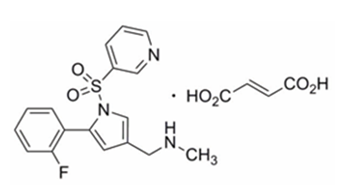
Vonoprazan (as the fumarate), is a potassium-competitive acid blocker. Chemical name: 1H-pyrrole-3 methanamine, 5-(2-fluorophenyl)-N-methyl-1-(3-pyridinylsulfonyl)-, (2E)-2-butenedioate (1:1). Molecular formula: C17H16FN3O2S•C4H4O4 Molecular weight: 461.5.
8.0 Pharmaceutical Particulars
8.1 Incompatibilities
None.
8.2 Shelf-Life
Refer on pack.
8.3 Packaging Information
10×10 Tablet
8.4 Storage and Handling Instructions
Store below 30°C. Keep the medicine out of reach of children
9.0 Patient Counselling Information
Acute Tubulointerstitial Nephritis: To call their healthcare provider if they experience signs and/or symptoms associated with acute tubulointerstitial nephritis
Clostridioides difficile-Associated Diarrhoea: To immediately call their healthcare provider if they experience diarrhoea that does not improve
Bone Fracture: To report any fractures, especially of the hip, wrist, or spine, to their healthcare provider
Severe Cutaneous Adverse Reactions: To discontinue Vonoprazan and report to their healthcare provider at first appearance of a severe cutaneous adverse reaction or other sign of hypersensitivity
Vitamin B12 (Cobalamin) Deficiency: To report any clinical symptoms that may be associated with Vitamin B12 deficiency to their healthcare provider, if they have been receiving Vonoprazan long-term.
Hypomagnesemia and Mineral Metabolism: To report any clinical symptoms that may be associated with hypomagnesemia, hypocalcemia, and/or hypokalemia to their healthcare provider
Drug Interactions: To report to their healthcare provider if they start treatment with rilpivirine-containing products
Pregnancy: Do not take this medicine during pregnancy unless advised by physician.
Lactation: To not breastfeed during treatment with Vonoprazan
Important Administration Instructions: Vonoprazan can be taken with or without food. Swallow Vonoprazan tablets whole; do not chew or crush the tablet.