4.0 Clinical Particulars
4.1 Therapeutic Indications
Sofitol Syrup is indicated for treatment of chronic constipation and prevention of hepatic encephalopathy.
4.2 Posology and Method of Administration
Constipation
Lactitol Syrup should be administered once daily in the morning or evening (at mealtime). The choice between morning and evening should be left to the patient depending on his or her individual response to the product.
The laxative effect usually occurs a few hours after taking Lactitol Syrup. The patient should be told that in some case laxative action may not begin until the 2nd and 3rd day after the initial dose. Patient should be advised to maintain an adequate daily intake of fluid.
Adult patient
The usual recommended dose of Lactitol Syrup is 15 to 30 ml per day.
Paediatric patient
The usual recommended dose of Lactitol Syrup for children between age group 2 to 6 years is 10ml per day. For children above age of 6 years the recommended dose is 10 to 15 ml per day.
Hepatic encephalopathy
For the prevention of hepatic encephalopathy the recommended dose of Lactitol Syrup is 30ml once daily in the evening. The usual recommended dose for the treatment of acute hepatic encephalopathy is 45 to 90 ml divided into 3 dose along with the main meals.
4.3 Contraindications
- Appendicitis
- Patients with intestinal obstruction, or in cases of unexplained abdominal pain or bleeding.
- Hypersensitivity to the drug or other component of the formulation.
- Galactosemia
4.4 Special Warnings and Precautions for use
Absorption of lactate from colonic metabolism of lactitol can potentially result in acid-base disturbance. Diarrhea induced by lactitol can be associated with hypokalemia and hypernatremia. Potassium deficiency may increase the risk of toxic effects of glycosides in patients receiving concomitant therapy. Periodic monitoring of serum electrolytes, blood glucose and blood lactate is suggested. If watery stools are noticed, one either reduce the quantity of administration or suspend administration. As with all Laxatives, any pre-exciting electrolyte or water balance abnormalities must be corrected. Blood electrolyte levels should be monitored regularly in elderly or debilitated patients on long term treatment. Patient who has complain of nausea should be advised to take lactitol with meal. Lactitol is not recommended in case of ileostomy. Fecal impaction should be treated by alternative methods prior to using lactitol. Following treatment with lactitol, hydrogen may be accumulated in the bowel. Patients who need to undergo electrocauterisation procedures should therefore have a bowel cleaning with a non fermentable solution. All cases of chronic constipation should first be treated by a fibre rich diet, intake of liquids or physical activity. Prolonged use of laxatives without interruption should be avoided. Typical symptoms of laxative overdose include abdominal pain, weakness, fatigue, thirst, vomiting, edema, bone pain (due to osteomalacia), fluid and electrolyte imbalance, hypoalbuminemia (due to protein losing gastroenteropathy) and syndromes that mimic colitis. If presence of air is perceived in the intestine, it is advisable to begin the treatment with the minimum dose, gradually increasing based on the therapeutic response. Should not be given to patients with galactosaemia or intestinal obstruction. It should not be used in patients on a low galactose diet and care should be taken in patients with lactose intolerance or in diabetic patients because of the presence of some free galactose.
4.5 Drug Interactions
Lactitol can increase the potassium losses caused by other medicines (e.g. thiazide diuretics, corticosteroids, carbenoxolone, amphoterican B). Potassium deficiency may increase the risk of toxic effects of glycosides in patients receiving concomitant therapy. Lactitol can also increase digitalis toxicity. Concomitant administration of lactitol with neomycin can cause an increase in neomycin activity. If large spectrum antibacterial agents are administered along with lactitol it can cause a reduction in acidification effect on intestinal microflora and consequently limiting therapeutic efficacy.
4.6 Use in Special Population
Pregnancy
Lactitol is minimally absorbed after oral administration, and it is not known whether its use during pregnancy results in exposure of the fetus to the drug. Available data from limited reports in pregnant women are insufficient to determine any risk of major birth defects, miscarriage, or adverse maternal or fetal outcomes.
Animal studies conducted in rats and rabbits during organogenesis showed no evidence of harm to the fetus at doses higher than the recommended human dose.
Sofitol Syrup should therefore be used during pregnancy only if clearly needed and when the potential benefit to the mother outweighs the possible risk to the fetus.
Lactation
There are no available data on the presence of lactitol in human or animal breast milk, its effects on the breastfed infant, or its effect on milk production. Since lactitol is minimally absorbed after oral administration, the extent of exposure to a breastfed infant is unknown.
The benefits of breastfeeding should be considered along with the mother's clinical need for Sofitol Syrup and any potential risk to the breastfed infant.
No studies have been conducted to determine whether lactitol is excreted in breast milk.
4.7 Effects on Ability to Drive and Use Machines
Lactitol has no or negligible influence on the ability to drive and use machines.
4.8 Undesirable Effects
Abdominal distension or cramp and flatulence have occurred most frequently, these effects are most prevalent during the first 10 days of treatment and tend to subside on continued administration. Other less frequent side effects include abdominal discomfort, nausea, dyspepsia, epigastric pain, urgency of defecation, borborygmi or anal pruritus and vomiting in rare cases. Diarrhea occurs generally with excessive doses of lactitol but some experience diarrhea at the recommended dosage. A reduction in dosage will overcome this problem. Severe flatulence, nausea and epigastric pain have occasionally necessitated withdrawal of lactitol therapy. Absorption of lactate resulting from colonic metabolism of Lactitol can potentially result in acid-base disturbances. Diarrhea induced by lactitol can be associated with hypokalemia and hypernatremia.
Reporting of Suspected Adverse Reactions
Reporting suspected adverse reactions after authorization of the medicinal product is important. It allows continued monitoring of the benefit/risk balance of the medicinal product. Healthcare professionals are asked to report any suspected adverse reactions via email to: medico@zorvia.com
By reporting side effects, you can help provide more information on the safety of this medicine.
4.9 Overdose
The appearance of diarrhea and abdominal cramps is a sign of overdosage which requires dose reduction. Overdose may also cause a shift in serum electrolytes which may require corrective therapy. In case of overdosage, periodic monitoring of serum electrolytes is suggested.
5.0 Pharmacological Properties
5.1 Mechanism of Action / Pharmacodynamic Properties
Lactitol is sugar alcohol consisting of galactose and sorbitol, which is minimally absorbed and is not hydrolyzed by the disaccharidases of the gastrointestinal tract and thus reaches the colon unchanged. It breaks down in the colon to short chain organic acid mainly acetic, propionic and butyric acid, by the intestinal flora, in particular by the bacteroides and lactobacilli, thus acidifying the content of the colon. The effect of this acidification is to reduce the absorption of ammonia. The transformation of lactitol into low molecular weight organic acid results in an increase in osmotic pressure in the colon thereby causing an increase in the stool water content and stool volume which explain the laxative effect. The mechanism of action in hepatic encephalopathy is related to suppression of the absorption of unionized ammonia via lowering of colonic pH, a cathartic action also enhances fecal nitrogen excretion and decrease intestinal transit time, with a reduction in the time for production and absorption of ammonia and other potential toxins. Other speculated mechanism includes stimulation of ammonia.
5.2 Pharmacokinetic Properties
Lactitol is not significantly absorbed in the small intestine, only 0.5% to 2% of a dose is partially absorbed. Upon reaching the colon, lactitol is rapidly and extensively metabolized to volatile fatty acids by the bacterial metabolism resulted in carbon dioxide formation and loss of 27.4% of the dose, 64% of the dose was calculated to be absorbed by the colonic mucosa as volatile fatty acids, with 6.5% excreted in the feces. Small amounts of unchanged lactitol appear in the urine (2 % of less of a dose).
6.1 Animal Toxicology or Pharmacology
A perinatal and postnatal study of lactitol, a hepatic encephalopathy drug was conducted in Sprague-Dawley rats. Female rats were given lactitol orally at dose levels of 0 (control), 0.7, 2.65 and 10 g/kg from day 17 of pregnancy to day 21 after delivery. All pregnant rats per level were allowed to deliver naturally for postnatal examination of their offspring. The high dose caused diarrhea or soft stool in dams. The high dose suppressed the body weight of dams during the perinatal period. The food consumption of dams decreased in the intermediate and high dose groups. The water consumption of dams increased in the high dose group. The high dose caused enlargement of cecum and increase of weights of cecum in dams. The drug failed to affect the delivery of dams and gestation index. However, high dose caused prolongation of gestation period. Two dams in the high dose group failed to nurse their all newborns during early lactation. The drug did not affect the number of live newborns, birth index, external appearance, body weight, viability index, weaning index, and sex ratio of weanlings. Nor did lactitol have any adverse effect on the postnatal development of the first (F1) generation offspring, such as differentiation, emotionality, motor ability, learning ability or reproductive performance. Nor did lactitol have any adverse effect on the second (F2) generation offspring. The results show that the no-effect dose levels of lactitol are 0.7 g/kg for general toxicity in mother animals, 2.65 g/kg for reproductive function in mother animals, and 10 g/kg for their offspring.
7.0 Description
Lactitol is an osmotic laxative for oral use. Lactitol is a simple monosaccharide sugar alcohol.
Molecular Formula: C12H26O12
Molecular Weight: 362.33 g/mol
8. Pharmaceutical particulars
8.1 Incompatibilities
Not applicable
8.2 Shelf-Life
Refer on pack
8.3 Packaging Information
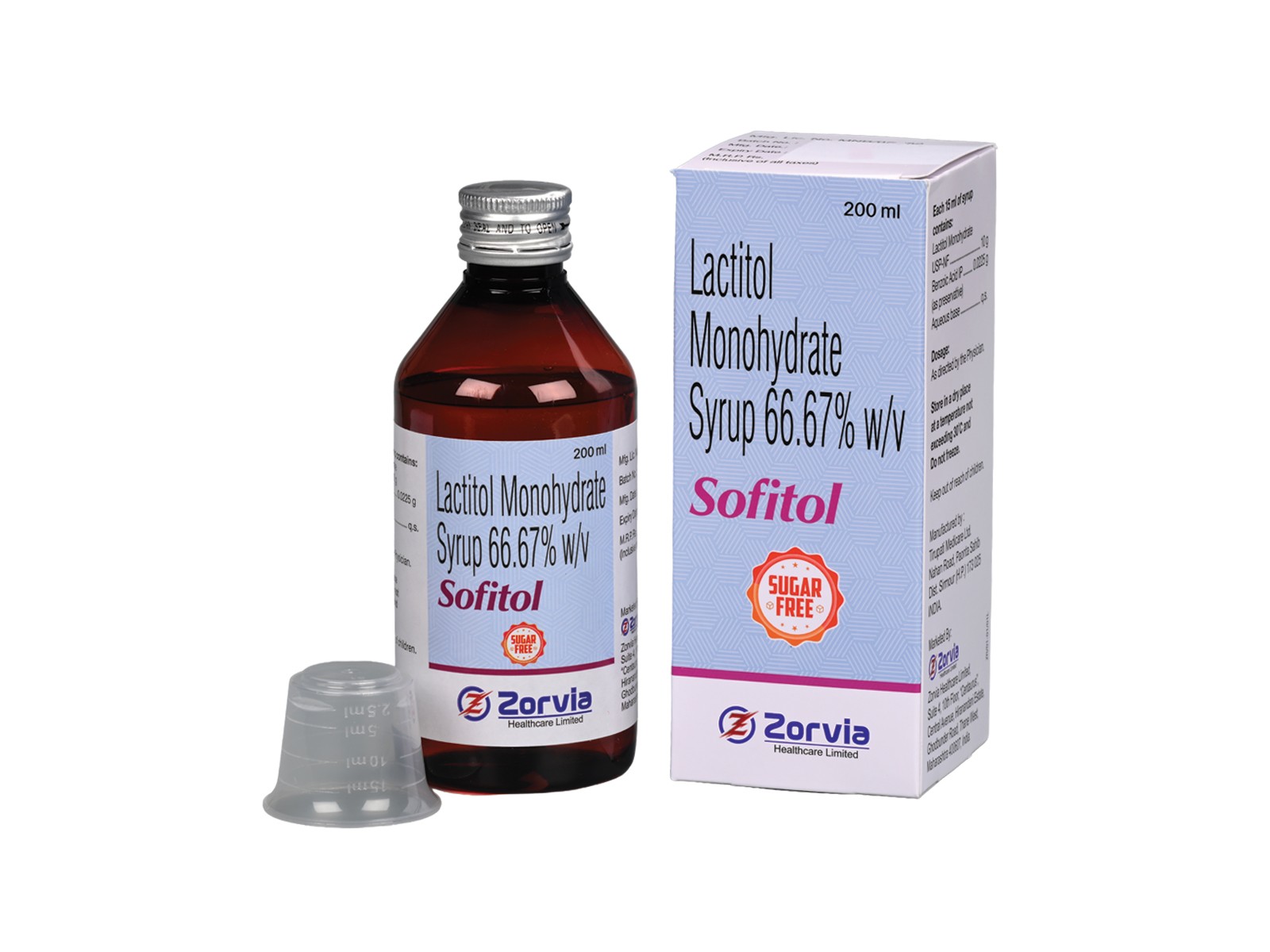
200 ml Bottle
8.4 Storage and Handling Instructions
Store in a dry place at a temperature not exceeding 30°C and Do not freeze.
9.0 Patient Counselling Information
Advise patients to stop Sofitol syrup and contact their healthcare provider if they experience persistent loose stools.