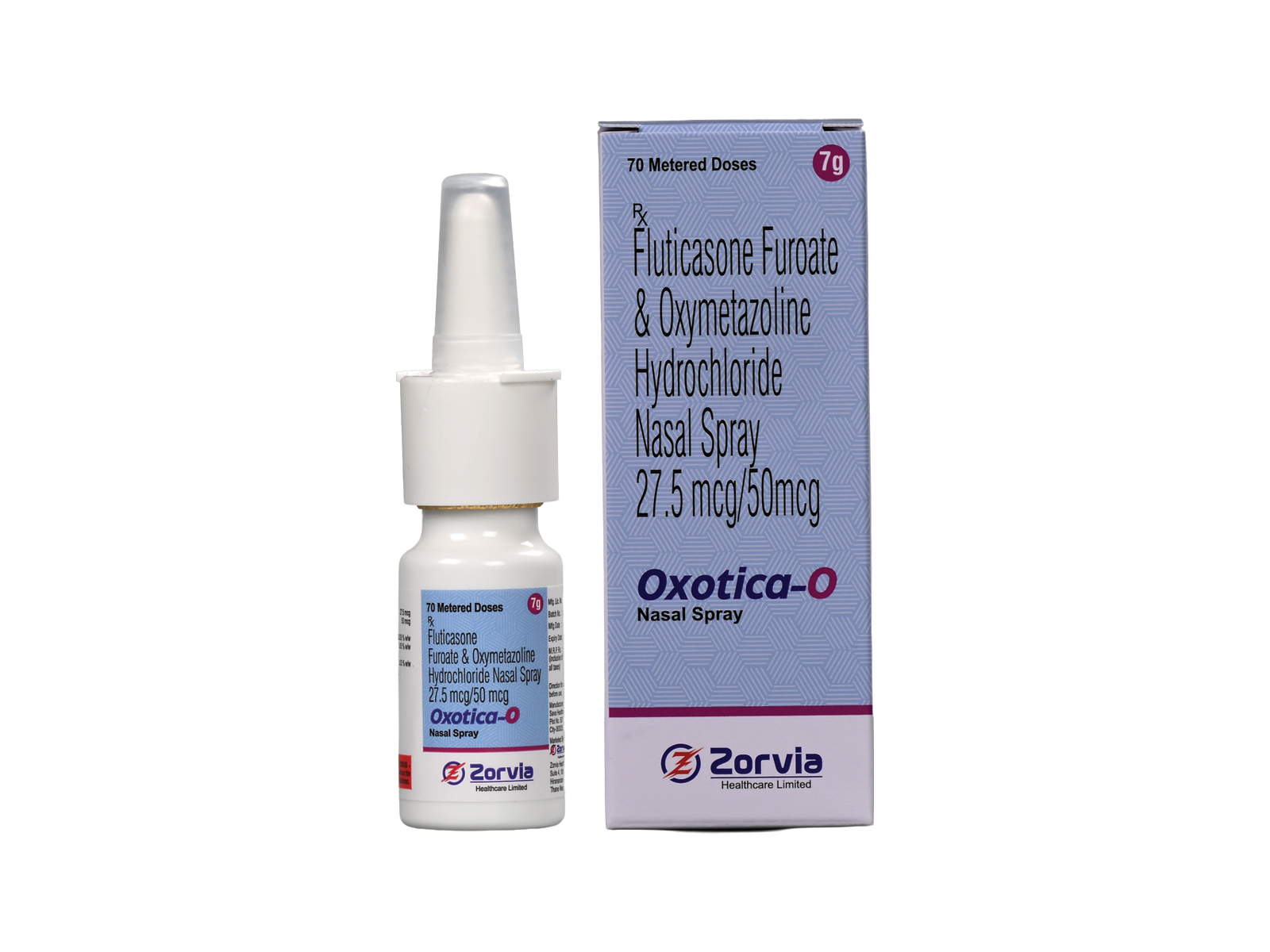
Intranasal spray containing 27.5 mcg of fluticasone furoate and 50 mcg of oxymetazoline hydrochloride.
4.0 Clinical Particulars
4.1 Therapeutic Indications
For the treatment of symptoms of allergic rhinitis with nasal congestion.
4.2 Posology and Method of Administration
Oxotica-O should be administered by the intranasal route only.
Adults and Adolescents (12 years of age and older) Two spray per nostril once daily. Once symptom control is achieved, reducing the dose to one spray in each nostril once daily may be effective for maintenance.
Children (<12 Years of Age) Fluticasone Furoate and Oxymetazoline Hydrochloride Nasal Spray should not be used in children less than 12 years of age.
Shake the bottle well before each use. For Intranasal use only. Do not spray in the mouth and eyes.
4.3 Contraindications
This medicine is contraindicated in patients with:
Hypersensitivity to Fluticasone Furoate, Oxymetazoline Hydrochloride, or to any of the excipients of the formulation.
Children below 12 years of age.
Recent trans-nasal surgery.
Chronic nasal inflammation associated with very dry nasal passages (rhinitis sicca or atrophic rhinitis).
Cardiovascular disease.
Hyperthyroidism.
Angle-closure glaucoma.
Prostatic enlargement.
4.4 Special Warnings and Precautions for use
Keep the spray away from the eyes.
Systemic corticosteroid effects Systemic effects of nasal corticosteroid may occur, particularly at high doses prescribed for prolonged periods. These effects are much less likely to occur than with oral corticosteroids and may vary in individual patients and between different corticosteroid preparations. Potential systemic effects may include Cushing's syndrome, Cushingoid features, adrenal suppression, growth retardation in children and adolescents, cataract, glaucoma and more rarely, a range of psychological or behavioral effects including psychomotor hyperactivity, sleep disorders, anxiety, depression or aggression (particularly in children). Treatment with higher than recommended doses of nasal corticosteroids may result in clinically significant adrenal suppression. If there is evidence for higher than recommended doses being used, then additional systemic corticosteroid cover should be considered during periods of stress or elective surgery, Fluticasone furoate 110 micrograms once daily has not been associated with hypothalamic-pituitary-adrenal (HPA) axis suppression in adult or adolescent subjects.
However, the dose of intranasal fluticasone furoate should be reduced to the lowest dose at which effective control of the symptoms of rhinitis is maintained. As with all intranasal corticosteroids, the total systemic burden of corticosteroids should be considered whenever other forms of corticosteroid treatment are prescribed concurrently.
If there is any reason to believe that adrenal function is impaired, care must be taken when transferring patients from systemic steroid treatment to fluticasone furoate.
Visual disturbance Visual disturbance may be reported with systemic and topical corticosteroid use. If a patient present with symptoms such as blurred vision or other visual disturbances, the patients should be considered for referral to an ophthalmologist for evaluation of possible causes which may include cataract, glaucoma or rare disease such as central serious chorioretinopaty (CSCR) which have been reported after use of systemic and topical corticosteroids.
Growth retardation Growth retardation has been reported in children receiving nasal corticosteroids at licensed doses. A reduction in growth velocity has been observed in children treated with fluticasone furoate 110 micrograms daily for one year. Therefore, children should be maintained on the lowest possible efficacious dose which delivers adequate symptom control.
4.5 Drug Interactions
Interaction with CYP3A inhibitors Fluticasone furoate is rapidly cleared by extensive first pass metabolism medicated by the cytochrome P450 3A4. Based on data with another glucocorticoid (fluticasone propionate), that is metabolized by CYP3A4, co-administration with ritonavir is not recommended because of the risk of increased systemic exposure of fluticasone furoate. Caution is recommended when co-administering fluticasone furoate with potent CYP3A inhibitors including cobicistat containing products as an increase in the risk of systemic side effects is expected. Co-administration should be avoided unless the benefit outweighs the increased risk of systemic corticosteroid side effects, in which case patients should be monitored for systemic corticosteroid side effects. In a drug interaction study of intranasal fluticasone furoate with the potent CYP3A4 inhibitor ketoconazole there were more subjects with measurable fluticasone furoate concentrations in the ketoconazole group (6 of the 20 subjects) compared to placebo (1 out of 20 subjects). This small increase in exposure did not result in a statistically significant difference in 24-hour serum cortisol levels between the two groups.
The enzyme induction and inhibition data suggest that there is no theoretical basis for anticipating metabolic interactions between fluticasone furoate and the cytochrome P450 mediated metabolism of other compounds at clinically relevant intranasal doses. Therefore, no clinical studies have been conducted to investigate interactions of fluticasone furoate on other drugs.
Monoamine oxidase inhibitors (MAOIs), nonselective beta-adrenergic antagonists, or tricyclic antidepressants Use of Oxymetazoline containing nasal spray in combination with monoamine oxidase inhibitors (MAOIs), nonselective beta-adrenergic antagonists, or tricyclic antidepressants may cause hypertension and is not recommended.
4.6 Use in special populations
Pediatric patients (< 12 years of age) Fluticasone Furoate and Oxymetazoline Hydrochloride Nasal Spray should not be used in children less than 12 years of age.
Geriatric patients (equal to or above 65 years) No dose adjustment is required in the population
Patients with renal impairment No dose adjustment is required in this population
Patients with hepatic impairment No dose adjustment is required in this population
Pregnant women There are no adequate data from the use of fluticasone furoate and Oxymetazoline containing nasal sprays in pregnant women. In animal studies glucocorticoids have been shown to induce malformations including cleft palate and intra-uterine growth retardation. This is not likely to be relevant for humans given recommended nasal doses which results in minimal systemic exposure.
Lactating women It is unknown whether nasal administered fluticasone furoate or Oxymetazoline is excreted in human breast milk. Administration of Fluticasone Furoate and Oxymetazoline Hydrochloride Nasal Spray to women who are breast-feeding should only be considered if the expected benefit to the mother is greater than any possible risk to the child.
Fertility There are no fertility data in humans
4.7 Effects on Ability to Drive and Use Machines
Oxotica-O nasal spray has no or negligible effect on the ability to drive and use machines.
4.8 Undesirable Effects
The most common Adverse Events reported with the use of Fluticasone Furoate and Oxymetazoline Hydrochloride Nasal Spray are epistaxis, nasal ulceration, nasal dryness & discomfort, sneezing and headache.
The other adverse events include: rhinalgia, transient ocular changes, blurred vision, nasal septum perforation, dry mouth, stomatitis, dry throat, local irritation, insomnia, sedation, anxiety, irritability, nausea, hypertension, irregular heart rate, increased heart rate, restlessness, somnolence, fatigue, hypersensitivity reactions including anaphylaxis, angioedema, rash, and urticaria.
Prolonged use may cause rebound congestion and rhinitis medicamentosa.
Adverse reaction(s) with a frequency not known (cannot be estimated from the available data). Respiratory, thoracic and mediastinal disorders: Dysphonia, aphonia Nervous system disorders: Dysgeusia, ageusia, anosmia
Reporting of Suspected Adverse Reactions Reporting suspected adverse reactions after authorization of the medicinal product is important. It allows continued monitoring of the benefit/risk balance of the medicinal product. Healthcare professionals are asked to report any suspected adverse reactions via email to: medico@zorvia.com By reporting side effects, you can help provide more information on the safety of this medicine.
4.9 Overdose
Overdose may give rise to local irritation and rebound congestion. Treatment need only be symptomatic.
5.0 Pharmacological Properties
5.1 Mechanism of action
Fluticasone furoate is a synthetic tri-fluorinated corticosteroid that possesses a very high affinity for the glucocorticoid receptor and has a potent anti-inflammatory action.
Oxymetazoline is a direct-acting sympathomimetic amine. It acts on alpha-adrenergic receptors in the vessels of the nasal mucosa producing vasoconstriction and decongestion.
5.2 Pharmacodynamic properties
Fluticasone Furoate Absorption: Fluticasone furoate undergoes incomplete absorption and extensive first-pass metabolism in the liver and gut resulting in negligible systemic exposure. The intranasal dosing of 110 micrograms once daily does not typically result in measurable plasma concentrations (<10 pg/ml). The absolute bioavailability for intranasal fluticasone furoate is 0.50%, such that less than 1 microgram of fluticasone furoate would be systemically available after administration of 110 micrograms.
Distribution: The plasma protein binding of fluticasone furoate is greater than 99%. Fluticasone furoate is widely distributed with volume of distribution at steady-state of, on average, 608 L.
Biotransformation: Fluticasone furoate is rapidly cleared (total plasma clearance of 58.7 L/h) from systemic circulation principally by hepatic metabolism to an inactive 17β-carboxylic metabolite (GW694301X), by the cytochrome P450 enzyme CYP3A4. The principal route of metabolism was hydrolysis of the S-fluoromethyl carbothioate function to form the 17β-carboxylic acid metabolite. In vivo studies have revealed no evidence of cleavage of the furoate moiety to form fluticasone.
Elimination: Elimination is primarily via the faecal route following oral and intravenous administration indicative of excretion of fluticasone furoate and its metabolites via the bile. Following intravenous administration, the elimination phase half-life averaged 15.1 hours. Urinary excretion accounted for approximately 1% and 2% of the orally and intravenously administered dose, respectively.
Oxymetazoline Hydrochloride Oxymetazoline enters tissues rapidly and local vasoconstriction is normally achieved within 5-10 minutes of intranasal administration. The full effect lasts for 5-6 hours and then gradually subsides over the next 6 hours. Plasma half-life is 5-8 days with 30% of any absorbed drug being excreted in the urine unchanged and 10% being excreted in the faeces.
5.3 Pharmacokinetic properties
Fluticasone Furoate Absorption: Fluticasone furoate undergoes incomplete absorption and extensive first-pass metabolism in the liver and gut resulting in negligible systemic exposure. The intranasal dosing of 110 micrograms once daily does not typically result in measurable plasma concentrations (<10 pg/ml). The absolute bioavailability for intranasal fluticasone furoate is 0.50%, such that less than 1 microgram of fluticasone furoate would be systemically available after administration of 110 micrograms.
Distribution: The plasma protein binding of fluticasone furoate is greater than 99%. Fluticasone furoate is widely distributed with volume of distribution at steady-state of, on average, 608L.
Biotransformation: Fluticasone furoate is rapidly cleared (total plasma clearance of 58.7 L/h) from systemic circulation principally by hepatic metabolism to an inactive 17β-carboxylic metabolite (GW694301X), by the cytochrome P450 enzyme CYP3A4. The principal route of metabolism was hydrolysis of the S-fluoromethyl carbothioate function to form the 17β-carboxylic acid metabolite.
Elimination: Elimination is primarily via the faecal route following oral and intravenous administration indicative of excretion of fluticasone furoate and its metabolites via bile. Following intravenous administration, the elimination phase half-life averaged 15.1 hours. Urinary excretion accounted for approximately 1% and 2% of the orally and intravenously administered dose, respectively.
Oxymetazoline hydrochloride Oxymetazoline enters tissues rapidly and local vasoconstriction is normally achieved within 5-10 minutes of intranasal administration. The full effect lasts for 5-6 hours and then gradually subsides over the next 6 hours. Plasma half-life is 5-8 days with 30% of any absorbed drug being excreted in the urine unchanged and 10% being excreted in the faeces.
6.0 Nonclinical Properties
6.1 Animal Toxicology or Pharmacology
Fluticasone Furoate Findings in general toxicology studies were similar to those observed with other glucocorticoids and are associated with exaggerated pharmacological activity. These findings are not likely to be relevant for humans given recommended nasal doses that result in minimal systemic exposure. No genotoxic effects of fluticasone furoate have been observed in conventional genotoxicity tests. Further, there were no treatment-related increases in the incidence of tumours in 2-year inhalation studies in rats and mice.
Oxymetazoline Hydrochloride There are no preclinical data of relevance.
7.0 Description
Fluticasone Furoate and Oxymetazoline Hydrochloride Nasal Spray is white to off white suspension in a pre-filled intranasal sprayer. The pH of suspension is 5.0 ± 1.0. The product contains two active ingredients: Fluticasone Furoate and Oxymetazoline Hydrochloride.
The chemical name of fluticasone Furoate is (6α,11β,16α,17α)-6,9-difluoro-17-{[(fluoro-methyl)thio]carbonyl}-11-hydroxy-16-methyl-3-oxoandrosta-1,4-dien-17-yl 2-furancarboxylate. The molecular weight is 538.6.
The chemical formula of Oxymetazoline Hydrochloride is 3-[(4,5-dihydro-1H-imidazol-2-yl)methyl]-6-(1,1-dimethylethyl)-2,4-dimethylphenol mono-hydrochloride. Its molecular weight is 296.8 for the hydrochloride salt and 260.4 for the free base.
Store below 30°C, Shake well before each use. Keep out of reach of children.
9.0 Patient Counselling Information
Keep the spray away from the eyes.
Prolonged use of spray may lead to systemic corticosteroid effects. Consult your physician for duration of use of the product.
Do not use the product in children less than 12 years of age
Do not use the product if you have cardiovascular disease, hyperthyroidism, angle closure glaucoma or prostatic enlargement. Do not use the product if you have undergone recent trans-nasal surgery, or in case of chronic nasal inflammation with very dry nasal passages (rhinitis sicca or atrophic rhinitis).