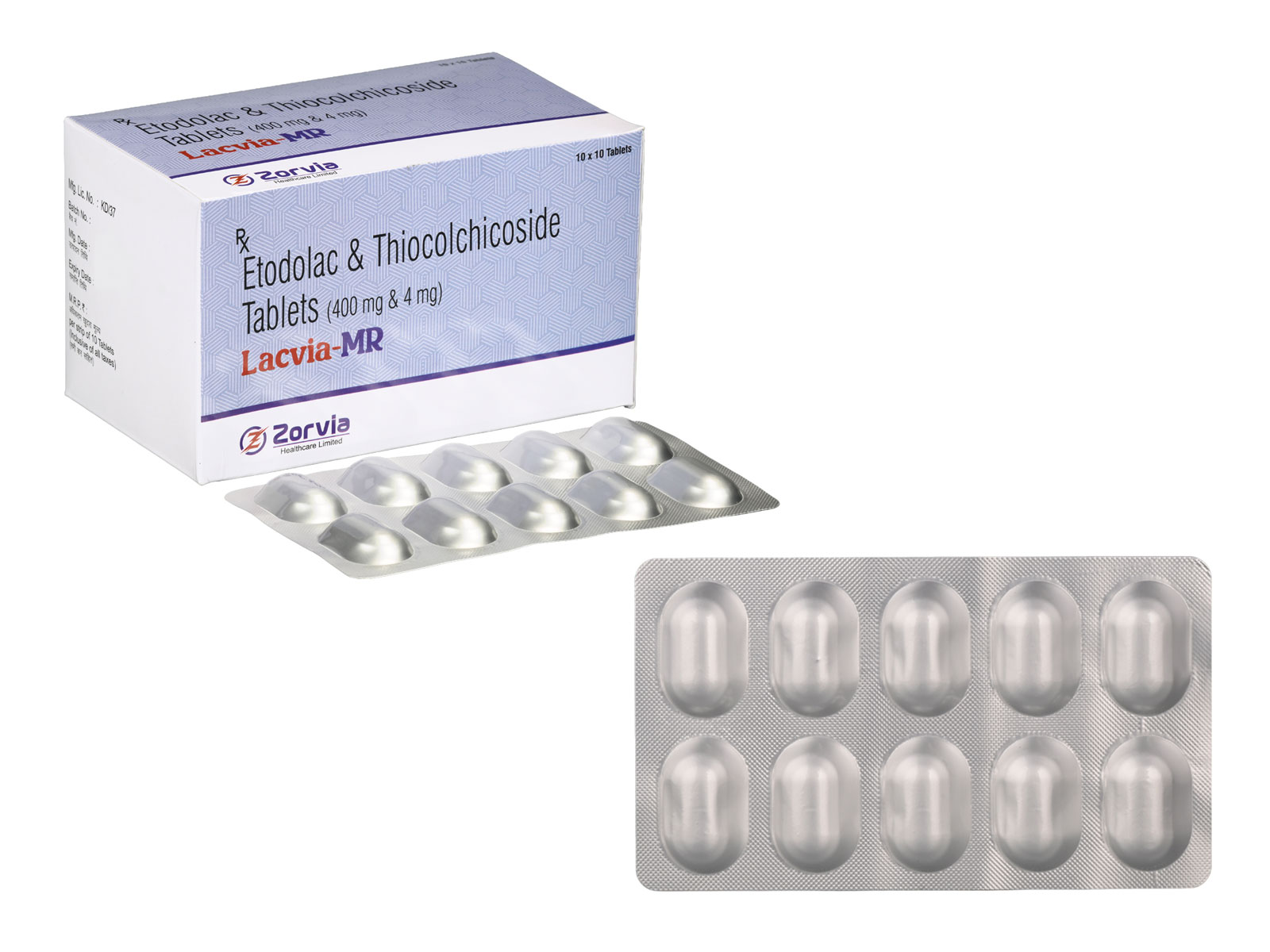
1. What is Lacvia-MR tablet and what it is used for
Lacvia®-MR is a combination of 400 mg of Etodolac and 4 mg of Thiocolchicoside.
Etodolac one of a group of medicines called "non-steroidal anti-inflammatory drugs" (NSAIDs) which are usually taken to relieve the pain, stiffness, inflammation and swelling which is often associated with arthritis. Etodolac has anti-inflammatory, analgesic, and antipyretic activities.
Thiocolchicoside is a sulfur-containing, semi-synthetic analog of colchicine, which behaves pharmacologically as a muscle relaxant, both in humans and in animals. It is a muscle relaxant with anti-inflammatory and analgesic effects. It is used in adults and adolescents from 16 years onwards as an adjuvant treatment for painful muscular contractions. It is to be used for acute conditions related to spinal column.
Lacvia®-MR tablets is used for the treatment of patients with acute painful musculoskeletal conditions. Acute painful musculoskeletal conditions refer to sudden and often severe pain and discomfort affecting the muscles, bones, joints, ligaments, or tendons. These conditions can arise from various causes such as injury, overuse, inflammation, or infection. Common examples include Muscle sprains and strains, fractures, tendonitis, bursitis, muscle spasms, acute gout, Spondyloarthropathies.
2. What you need to know before you take Lacvia-MR tablet
DO NOT take Lacvia®-MR Tablets if you:
- If you are allergic to etodolac or thiocolchicoside
- If you are pregnant or are breast feeding.
- If you are women of childbearing potential who are not using effective contraception.
- If you have experienced asthma, urticaria, or allergic-type reactions after taking aspirin or other NSAIDs.
- If you have a peptic ulcer or history of recurrent peptic ulceration or a history of peptic ulcer disease.
Warnings and Precautions
Talk to your doctor or pharmacist before taking Lacvia®-MR Tablets.
- If you have epilepsy or at risk for seizures.
- If you suffer from kidney, heart or liver disease (including alcoholic liver disease), or a blood disorder, especially if you are also taking diuretics (water tablets). The dose should be as low as possible and you should have regular checks.
- If you suffer from fluid retention (swelling of legs, ankles or feet).
- If you suffer from high blood pressure or heart failure.
- If you suffer from, or have ever suffered from, asthma or breathing difficulties.
- If you have heart problems, previous stroke or think that you might be at risk of these conditions (for example if you have high blood pressure, diabetes or high cholesterol or are a smoker).
- If you suffer from chronic alcoholism, excessive alcohol intake (3 or more alcoholic drinks every day), anorexia, bulimia or cachexia; chronic malnutrition (low reserves of hepatic glutathione), dehydration, and hypovolemia.
- If you have coagulation disorders or are receiving anticoagulants, hemoglobin or haematocrit should be carefully monitored.
- If you suffer from G-6-PD deficiency (a hereditary condition leading to low red blood cell counts).
- If you have systemic lupus erythematosus (SLE) and mixed connective tissue disorders.
Medicines such as Lacvia®-MR Tablets may be associated with a small increased risk of heart attack (myocardial infarction) or stroke. Any risk is more likely with high doses and prolonged treatment. Do not exceed the recommended dose or duration of treatment.
Serious gastrointestinal side effects such as bleeding, ulceration and perforation can occur at any time with or without warning symptoms in patients treated with NSAIDs. If any sign of gastrointestinal bleeding occurs, Lacvia®-MR Tablets should be stopped immediately.
Children
Lacvia®-MR Tablets are not recommended for use in children.
Other medicines and Lacvia®-MR Tablets
Tell your doctor if you are taking, have recently taken or might take any other medicines.
Tell your doctor if you are taking:
- ACE inhibitors
- Aspirin
- Other analgesics including cyclooxygenase-2 selective inhibitor
- Anti-hypertensive
- Diuretics
- Cardiac glycosides
- Lithium
- Cyclosporin, Digoxin, Methotrexate
- Anti-coagulants
- Anti-platelet agents and selective serotonin reuptake inhibitors (SSRIs)
- Tacrolimus
- Zidovudine
- Mifepristone
- Corticosteroids
- Quinolone antibiotics
- Phenylbutazone
- Chloramphenicol
Pregnancy, breast-feeding and fertility
If you are pregnant or breast-feeding, think you may be pregnant or are planning to have a baby, ask your doctor or pharmacist for advice before taking this medicine.
You should inform your doctor if you have problems becoming pregnant. NSAIDs may make it more difficult to become pregnant.
Do not take Lacvia®-MR Tablets if you are pregnant or women of childbearing potential who are not using effective contraception.
Lacvia®-MR Tablets should not be used if you are breast-feeding. It is known to pass into breast milk. It is not recommended for use during breast-feeding.
Geriatric use
If you are elderly, select the dose carefully, and monitor renal function.
Driving and using machines
Lacvia®-MR may cause dizziness or somnolence. So, you should not drive or operate heavy machinery if you feel dizzy or not fully alert.
3. How to take Lacvia-MR tablet?
Always take Lacvia®-MR Tablets exactly as your doctor told you. Check with your doctor or pharmacist if you are not sure. Check the pharmacist's label for the dose recommended for you.
The recommended adult dose is one Lacvia®-MR tablet twice a day.
The tablet should be swallowed whole with a glass of water. Take with or after food. Do not chew or crush the tablet.
Lacvia®-MR Tablets are not recommended for use in children.
If you take more Lacvia®-MR Tablets than you should
If you take more tablets than you should (an overdose), seek medical attention immediately. Always take the bottle (or packaging) with you, even if empty.
Symptoms of overdose include headache, feeling sick, vomiting, stomach pain, passing blood in faeces or passing black tarry stools. On rare occasions diarrhea, disorientation, excitation, coma, drowsiness, dizziness, ringing in the ears, fainting, and convulsive fitting may occur. In cases of significant overdose kidney failure and liver damage are possible. In some cases, irregular heartbeat and inflammation of the pancreas is also reported.
If you forget to take Lacvia®-MR Tablets
Do not take a double dose to make up for the forgotten dose. Take your tablet as soon as you remember and continue to take your medicine as usual, but do not take more than one tablet a day.
4. Possible Side Effects
Like all medicines, this medicine can cause side effects, although not everybody gets them.
The most serious side effects that may occur with Lacvia®-MR Tablets are serious allergic or hypersensitivity reactions, heart failure, stroke, kidney failure, liver failure, inflammation of the pancreas and aseptic meningitis. If you suffer from any of the symptoms described below: stop taking Lacvia®-MR Tablets and call a doctor straight away.
Allergic or hypersensitivity reactions may have the following symptoms:
wheezing, difficulty breathing or shortness of breath, swelling of the face, lips, mouth or tongue extensive rash, peeling or blistering of the skin, continuous itching.
Heart and blood circulatory disorders symptoms:
Chest pain, high blood pressure, swelling of the ankles, palpitations (throbbing of heart), several types of anaemia or other blood disorders, unexpected bruising and bleeding.
Stomach and bowel (gastrointestinal) problems:
If you
- Pass blood in your faeces (stools/motions)
- Pass black tarry stools.
- Vomit any blood or dark particles that look like coffee grounds.
Kidney failure symptoms:
Difficulty or pain when passing urine, discolouration of urine or urinating more or less often than usual.
Liver failure and inflammation of the pancreas symptoms:
Jaundice (yellowing of the eyes or skin), abdominal pain, abnormal liver function test results.
Meningitis (swelling of covering of the brain) symptoms
A serious rare condition known as aseptic meningitis may occur in patients with other auto-immune conditions such as systemic lupus erythematosus or mixed connective tissue disease.
The symptoms of aseptic meningitis are:
a very high temperature, being sick, a headache, a blotchy rash that does not fade when a glass is rolled over it (this may not develop), a stiff neck, a dislike of bright lights, drowsiness and fits.
Other reported side effects are:
Sensory disorders such as headache, ringing or buzzing in ears, dizziness, abnormal vision, hallucinations, tingling, pricking and burning of the skin (pins and needles) and vertigo (a sensation that objects are moving or spinning).
Gastrointestinal problems such as mouth ulcers, sore mouth, nausea, vomiting, stomach upsets, diarrhea, constipation, wind, heartburn, indigestion.
Skin disorders such as swelling of tissues, itching of the skin, rash, redness.
General disorders such as fever, drowsiness, tiredness, weakness, sleeplessness, shaking, nervousness, depression, confusion.
Rarely, Stevens-Johnson syndrome, and toxic epidermal necrolysis, a fatal skin reaction have been reported to occur.
If any of the side effects become serious, or if you notice any side effects not listed in this leaflet, please tell your doctor or pharmacist.
Reporting of side effects
If you get any side effects, talk to your doctor, healthcare provider or pharmacist. This includes any possible side effects not listed in this leaflet.
You can also report side effects directly: medico@zorvia.com
By reporting side effects, you can help provide more information on the safety of this medicine.
5. How Lacvia-MR tablets stored?
Lacvia-MR should be kept at room temperature (below 30°C).
Protect from light & moisture.
Keep out of reach of children.
6. Contents of the pack and other information
What Lacvia-MR tablet contains:
The active ingredient is etodolac (400mg) and Thiocolchicoside 4mg.
Other ingredients:
Colours: Red Oxide of Iron & Titanium Dioxide IP
What Lacvia-MR looks like and contents of the pack
- Film coated tablet
- Pack size: 10×10
Marketing Authorization Holder
Zorvia Healthcare Limited
Suite 4, 10th Floor, Centaurus, Central Avenue,
Hiranandani Estate, Ghodbunder Road,
Thane West, Maharashtra, India—400607.
This leaflet was last revised on 05/2026