4.0 Clinical Particulars
4.1 Therapeutic Indications
Cefuroxime injection, I.P. is indicated for the treatment of patients with infections caused by susceptible strains of the designated organisms in the following diseases:
1. Lower Respiratory Tract Infections, including pneumonia, caused by Streptococcus pneumoniae, Haemophilus influenzae (including ampicillin-resistant strains), Klebsiella spp., Staphylococcus aureus (penicillinase- and non-penicillinase-producing strains), Streptococcus pyogenes, and Escherichia coli.
2. Urinary Tract Infections caused by Escherichia coli and Klebsiella spp.
3. Skin and Skin-Structure Infections caused by Staphylococcus aureus (penicillinase-and non-penicillinase-producing strains), Streptococcus pyogenes, Escherichia coli, Klebsiella spp., and Enterobacter spp.
4. Septicaemia caused by Staphylococcus aureus (penicillinase- and non-penicillinase-producing strains), Streptococcus pneumoniae, Escherichia coli, Haemophilus influenzae (including ampicillin-resistant strains), and Klebsiella spp.
5. Meningitis caused by Streptococcus pneumoniae, Haemophilus influenzae (including ampicillin-resistant strains), Neisseria meningitidis, and Staphylococcus aureus (penicillinase-and non-penicillinase-producing strains).
6. Gonorrhoea: Uncomplicated and disseminated gonococcal infections due to Neisseria gonorrhoeae (penicillinase- and non-penicillinase-producing strains) in both males and females.
7. Bone and Joint Infections caused by Staphylococcus aureus (penicillinase- and non-penicillinase-producing strains).
Specimens for bacteriologic culture should be obtained prior to therapy in order to identify the causative organisms and to determine their susceptibility to cefuroxime. Therapy may be instituted before results of susceptibility testing are known. However, modification of the treatment may be required once these results become available.
Prevention
The preoperative prophylactic administration of Cefuroxime may prevent the growth of susceptible disease-causing bacteria and thereby may reduce the incidence of certain postoperative infections in patients undergoing surgical procedures (e.g., vaginal hysterectomy) that are classified as clean-contaminated or potentially contaminated procedures. Effective prophylactic use of antibiotics in surgery depends on the time of administration. Cefuroxime should usually be given one-half to 1 hour before the operation to allow sufficient time to achieve effective antibiotic concentrations in the wound tissues during the procedure. The dose should be repeated intra operatively if the surgical procedure is lengthy.
4.2 Posology and Method of Administration
Dosage and route of administration should be determined by severity of infection, susceptibility of the causative organism(s), and condition of the patient. The intravenous route is preferable for patients with severe or life-threatening infections. The usual duration of treatment is 5 to 14 days. For ß-haemolytic streptococcal infections, therapy should be continued for at least 10 days.
Adults
For most infections, the usual recommended dosage is 750 mg every 8 hours (2.25 g/day), administered intravenously. For severe or life-threatening infections, and for Gram-negative infections of the lower respiratory tract, a dosage of 1.5 g I.V. every 8 hours (4.5 g/day) is recommended. For treatment of bacterial meningitis, a dosage of 3 g I.V. every 8 hours (9 g/day) should be used.
For bone and joint infections, a dosage of 1.5g I.V. every 8 hours (4.5g/day) is recommended. Surgical intervention should be performed when indicated as an adjunct to cefuroxime therapy. A course of oral antibiotics should be administered when appropriate following the completion of parenteral administration of Cefuroxime injection, I.P.
Infants and Children (1 month to 12 years)
The usual dosage range is 30 to 100 mg/kg/day in 3 or 4 equally divided doses. A dose of 60 mg/kg/day is appropriate for most infections. In cases of bacterial meningitis*, a dosage of 200 to 240 mg/kg/day I.V. in 3 or 4 equally divided doses should be used.
For bone and joint infections, a dosage between 70 to 150 mg/kg/day administered intravenously every 8 hours is recommended. In clinical trials, a course of oral antibiotics was administered to children following the completion of parenteral administration of Cefuroxime injection, I.P. Doses in excess of the maximum adult dose should not be used in infants and children.
Neonates (up to 1 month)
In the first few weeks of life, the serum half-life of cefuroxime can be 3 to 5 times that in adults. Infections in neonates should be treated with dosages in the range of 30 to 100 mg/kg/day in 2 or 3 equally divided doses. For bacterial meningitis*, a dosage of 100 mg/kg/day I.V. in 2 or 3 equally divided doses should be used.
Dosage in Patients with Impaired Renal Function
For patients with markedly impaired renal function, a reduced dosage of Cefuroxime injection must be used. For adult patients with moderate infections, dosage adjustment may be made according to the guidelines listed.
Dosage Adjustment For Adult with Rental Insufficiency
| Creatinine Clearance | Unit Dose | Dosing Frequency | |
|---|---|---|---|
| mL/min/1.73 m2 | mL/s/ 1.73 m2 | ||
| >20 | >0.33 | 750 mg - 1.5 g | q8h |
| 10-20 | 0.17 - 0.33 | 750 mg | q12h |
| <10 | <0.17 | 750 mg | q24h |
Since Cefuroxime is dialyzable, patients on haemodialysis is should be given a further dose at the end of the dialysis.
For adults with severe infections who require doses higher than those recommended in Table, serum levels of cefuroxime should be monitored and dosage adjusted accordingly.
When only serum creatinine levels are known, the following formula may be used to estimate creatinine clearance. The serum creatinine must represent a steady state of renal function.
Males:
Creatinine clearance (mL/min) = Weight (kg)x (140-age)72 x serum creatinine (mg/dL)
OR
Creatinine clearance(mL/s) = Weight (kg)x (140-age)49 x serum creatinine (umol/L)
Females: 0.85 x male value
For patients on haemodialysis, a further 750 mg dose of Cefuroxime injection should be administered at the end of each dialysis treatment.
Method of administration
Intravenous
After constitution, Cefuroxime may be given intravenously or by deep IM injection into a large muscle mass (such as the gluteus or lateral part of the thigh). Before injecting intramuscularly, aspiration is necessary to avoid inadvertent injection into a blood vessel.
Intravenous Administration
The IV route may be preferable for patients with bacterial septicaemia or other severe or life-threatening infections or for patients who may be poor risks because of lowered resistance, particularly if shock is present or impending.
For direct intermittent IV administration, slowly inject the solution into a vein over a period of 3 to 5 minutes or give it through the tubing system by which the patient is also receiving other i.v solutions.
Reconstitution Data
For Intravenous Use: Constitute with Sterile Water for Injection.
| Strength | Amount of Diluent to be added(mL) | Volume to Be Withdrawn | Approximate Cefuroxime Concentration (mg/mL) |
|---|---|---|---|
| 750 -mg | Vial 3.0 (IM) | Total* | 225 |
| 750 -mg | Vial 8.3 (IV) | Total | 90 |
| 1.5 -gram | Vial 16.0 (IV) | Total | 90 |
For continuous IV infusion, a solution of Cefuroxime may be added to an IV infusion pack containing one of the following fluids: 0.9% Sodium Chloride Injection; 5% Dextrose Injection; 10% Dextrose Injection; 5% Dextrose and 0.9% Sodium Chloride Injection; 5% Dextrose and 0.45% Sodium Chloride Injection; or 1/6 M Sodium Lactate Injection.
Solutions of Cefuroxime like those of most beta-lactam antibiotics, should not be added to solutions of aminoglycoside antibiotics because of potential interaction.
However, if concurrent therapy with Cefuroxime and an aminoglycoside is indicated, each of these antibiotics can be administered separately to the same patient.
4.3 Contraindications
Known hypersensitivity to the cephalosporin group of antibiotics, including cefuroxime.
4.4 Special Warnings and Precautions for use
Before therapy with Cefuroxime injection is instituted; careful enquiry should be made to determine whether the patient has had previous hypersensitivity reactions to cefuroxime, cephalosporins, penicillins, or other drugs. Cefuroxime injection should be administered with caution to any patient who has shown some form of allergy, particularly to drugs. There is some clinical and laboratory evidence of partial cross allergenicity of the cephalosporins and penicillins. If an allergic reaction to Cefuroxime injection occurs, treatment should be discontinued and standard agents (e.g., epinephrine, antihistamines, corticosteroids) administered as required.
Pseudomembranous colitis has been reported to be associated with cefuroxime therapy (and other broad spectrum antibiotics). Therefore, it is important to consider its diagnosis in patients administered Cefuroxime injection who develop diarrhoea. Treatment with broad-spectrum antibiotics, including cefuroxime, changes the normal flora of the colon and may permit overgrowth of Clostridia. Studies indicate that a toxin produced by Clostridium difficile is one primary cause of antibiotic-associated colitis. Mild cases of colitis may respond to drug discontinuance alone.
Moderate to severe cases should be managed with fluid, electrolyte, and protein supplementation as needed.
Precautions
Cefuroxime injection should be administered with caution to individuals with a history of gastrointestinal disease, particularly colitis. Patients with markedly impaired renal function (i.e., creatinine clearance of 20 mL/min/1.73m2 or less) should be placed on the special dosage schedule for Cefuroxime injection recommended under DOSAGE AND ADMINISTRATION. Normal dosages in these individuals are likely to produce excessive serum concentrations of cefuroxime. The concomitant administration of aminoglycosides and some cephalosporins has caused nephrotoxicity. Although transient elevations of BUN and serum creatinine have been seen in clinical studies, there is no evidence that Cefuroxime injection, when administered alone, is significantly nephrotoxic.
Studies suggest that the concurrent use of potent diuretics, such as furosemide and ethacrynic acid, may increase the risk of renal toxicity with cephalosporins.
Prolonged treatment with Cefuroxime injection may result in the overgrowth of non-susceptible organisms, including species originally sensitive to the drug. Repeated evaluation of the patient's condition is required. If superinfection occurs during therapy, appropriate measures should be taken. Should an organism become resistant during antibiotic therapy, another antibiotic should be substituted.
As with other therapeutic regimens used in the treatment of meningitis, hearing loss has been reported in a few paediatric patients treated with Cefuroxime injection, I.P. Persistence of positive CSF cultures of Haemophilus influenzae at 18-36 hours has been noted with Cefuroxime injection, I.P.
4.5 Drug Interactions
In common with other antibiotics, cefuroxime may affect the gut flora, leading to lower estrogen reabsorption and reduced efficacy of combined estrogen/progesterone oral contraceptives.
4.6 Use in Special Population
Pregnancy
The safety of Cefuroxime injection in pregnancy has not been established. The use of Cefuroxime injection in pregnant women requires that the potential benefit from the drug be weighed against the possible risk to the mother and foetus.
Nursing Mothers
Cefuroxime is excreted in human milk in low concentrations (0.5 mg/L). Caution should be exercised when Cefuroxime injection is administered to a nursing mother.
Elderly Patients
The elimination of cefuroxime may be decreased due to impairment of renal function.
4.7 Effects on Ability to Drive and Use Machines
No studies on the effects of cefuroxime on the ability to drive and use machines have been performed. However, based on known adverse reactions, cefuroxime is unlikely to have an effect on the ability to drive and use machines.
4.8 Undesirable Effects
The following reactions have been observed during treatment with Cefuroxime injection, I.P.
Hypersensitivity
Rash, and eosinophilia. Anaphylaxis, urticaria, pruritus and drug fever have also been observed with cephalosporin treatment. Like other cephalosporins, there have been rare reports of erythema multiforme, Stevens-Johnson syndrome, toxic epidermal necrolysis (exanthematic necrolysis), and Fixed Drug Eruption (FDE).
Local reactions
Thrombophlebitis, stiffness at the site of injection, and inflammatory reactions at the site of injection; some degree of pain, after intramuscular injections when using water as diluent, has been observed.
Blood
Increased erythrocyte sedimentation rate and decreased haemoglobin; eosinophilia, leukopenia and neutropenia; some patients developed a positive direct Coombs 'test.
Renal
Increases in BUN and serum creatinine.
Hepatic
Transient increases in serum bilirubin, transaminases and alkaline phosphatase.
Others
Drowsiness, loose stools, faint feeling, sweating, palpitations and Candida intertrigo.
Reporting of Suspected Adverse Reactions
Reporting suspected adverse reactions after authorization of the medicinal product is important. It allows continued monitoring of the benefit/risk balance of the medicinal product. Healthcare professionals are asked to report any suspected adverse reactions via email to: medico@zorvia.com
By reporting side effects, you can help provide more information on the safety of this medicine.
4.9 Overdose
Overdosage of cephalosporins can cause cerebral irritation leading to convulsions. Other than general supportive treatment, no specific antidote is known. Excessive serum levels of cefuroxime can be reduced by dialysis.
5.0 Pharmacological Properties
5.1 Mechanism of Action / Pharmacodynamic Properties
Cefuroxime is a bactericidal agent that acts by inhibition of bacterial cell wall synthesis. Cefuroxime has activity in the presence of some beta-lactamases, both penicillinases and cephalosporinases, of Gram-negative and Gram-positive bacteria.
Resistance
Resistance to cefuroxime is primarily through hydrolysis by beta-lactamase, alteration of penicillin-binding proteins (PBPs), and decreased permeability.
Interaction with Other Antimicrobials
In an in vitro study antagonistic effects have been observed with the combination of chloramphenicol and cefuroxime.
Cefuroxime has been shown to be active against most isolates of the following bacteria, both in vitro and in clinical infections.
Gram-negative bacteria
- Enterobacter spp.
- Escherichia coli
- Klebsiella spp.
- Haemophilus influenzae
- Neisseria meningitidis
- Neisseria gonorrhoeae
Gram-positive bacteria
- Staphylococcus aureus
- Streptococcus pneumoniae
- Streptococcus pyogenes
The following in vitro data are available, but their clinical significance is unknown. At least 90 percent of the following microorganisms exhibit an in vitro minimum inhibitory concentration (MIC) less than or equal to the susceptible breakpoint for cefuroxime. However, the efficacy of cefuroxime in treating clinical infections due to these microorganisms has not been established in adequate and well-controlled clinical trials.
Gram-negative bacteria
- Citrobacter spp.
- Providencia rettgeri
- Haemophilus parainfluenzae
- Proteus mirabilis
- Moraxella catarrhalis
- Morganella morganii
- Salmonella spp.
- Shigella spp.
Gram-positive bacteria
- Staphylococcus epidermidis
5.2 Pharmacokinetic Properties
Absorption
Following intramuscular administration, peak levels of cefuroxime are achieved within 30-45 minutes. The serum half-life after either intramuscular or intravenous injection is approximately 70 minutes. The administration of probenecid concurrently prolongs the excretion of the antibiotic and produces an elevated peak serum level.
Distribution
Concentrations of cefuroxime in excess of the minimum inhibitory levels for common pathogens can be achieved in the bone, synovial fluid, and aqueous humor.
Cefuroxime crosses the blood-brain barrier when the meninges are inflamed.
Excretion
Unchanged cefuroxime is almost completely recovered in the urine within 24 hours of administration; the major part being eliminated in the first 6 hours. Approximately 50% is excreted through the renal tubules and approximately 50% by glomerular filtration.
6.0 Nonclinical Properties
6.1 Animal Toxicology or Pharmacology
Although lifetime studies in animals have not been performed to evaluate carcinogenic potential, no mutagenic activity was found for cefuroxime in the mouse lymphoma assay and a battery of bacterial mutation tests. Positive results were obtained in an in vitro chromosome aberration assay, however, negative results were found in an in vivo micronucleus test at doses up to 10 g/kg. Reproduction studies in mice at doses up to 3,200 mg/kg/day (3.1 times the recommended maximum human dose based on mg/m2) have revealed no impairment of fertility.
Reproductive studies revealed no impairment of fertility in animals.
7.0 Description
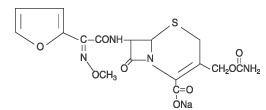
Cefuroxime, is a sterile semisynthetic, broad-spectrum, cephalosporin antibiotic for parenteral administration. It is the sodium salt of (6R,7R)-3-carbamoyloxymethyl-7-[Z-2-methoxyimino-2-(fur-2-yl)acetamido]ceph-3-em-4-carboxylate, cefuroxime chemical structure
Molecular formula: C16H15N4NaO8S
Molecular weight: 446.4
Structural formula
8.0 Pharmaceutical particulars
8.1 Incompatibilities
Cefuroxime should not be mixed in the syringe or giving set with aminoglycosides prior to or during administration.
8.2 Shelf-Life
Refer on the pack
8.3 Packaging Information
Refer on the pack
8.4 Storage and Handling Instructions
Store below 25°C. Protect from light & moisture.
Constituted solution for intravenous injection should be used within 4 hours if kept between 15 and 30C or 48 hours if stored under refrigeration. The further diluted solutions (1-30 mg/mL) for intravenous infusion should be used immediately after dilution or stored for up to 36 hours under refrigeration in the dark. Some increase in colour intensity may occur on storage.
9.0 Patient Counselling Information
Patients should be counseled that antibacterial drugs, including cefuroxime for injection, should only be used to treat bacterial infections. They do not treat viral infections (e.g., the common cold). When cefuroxime for injection is prescribed to treat a bacterial infection, patients should be told that although it is common to feel better early in the course of therapy, the medication should be taken exactly as directed. Skipping doses or not completing the full course of therapy may: (1) decrease the effectiveness of the immediate treatment, and (2) increase the likelihood that bacteria will develop resistance and will not be treatable by cefuroxime for injection or other antibacterial drugs in the future.
Diarrhea is a common problem caused by antibiotics which usually ends when the antibiotic is discontinued. Sometimes after starting treatment with antibiotics, patients can develop watery and bloody stools (with or without stomach cramps and fever) even as late as 2 or more months after having taken the last dose of the antibiotic. If this occurs, patients should contact their physician as soon as possible.
10. Details of Manufacturer
Zorvia Healthcare Limited
Suite 4, 10th Floor, “Centaurus”, Central Avenue, Hiranandani Estate,
Ghodbunder Road, Thane West, Maharashtra 400607, India.
At : Unit - II, Village: Teliwala, P.O. Manjholi, Tehsil: Nalagarh,
Distt. Solan, H.P. - 174101
® Registered Trademark of Eris Lifesciences Limited, used under license.
11. Details of permission or licence number with date
HP-MB-LL-00701 Dated : 03/11/2026
12. Date of Issue
17/11/2026