4.0 Clinical Particulars
4.1 Therapeutic Indications
Stimulates joint health recovery and flexibility.
4.2 Posology and Method of Administration
2 capsules once or twice daily on empty stomach or as directed by a Healthcare Professional.
4.3 Contraindications
Hypersensitivity to the active substance or to any of the excipients listed in the formulation.
4.4 Special Warnings and Precautions for use
Chondroitin sulfate may increase the anticoagulant activities of Warfarin.
Don't take chondroitin if you are taking warfarin.
Precaution:
This Product is consumed by adults only and not recommended for pregnant women,
lactating mothers and children below 5 years of age.
Supportive therapy for cartilage and joint health.
4.5 Drug Interactions
No known drug-drug interaction
4.6 Use in Special Population
Pregnancy & Lactation, usage in paediatrics
Precaution: This product is consumed by adults only and not recommended for
pregnant women, lactating mothers and children below 5 years of age.
Safety and efficacy in children have not been established.
4.7 Effects on Ability to Drive and Use Machines
No studies on the effects on the ability to drive and use machines have been performed.
4.8 Undesirable Effects
Collafour is a nutritional supplement, and it is generally regarded as safe for oral
consumption in adults.
In clinical studies, hydrolyzed Collagen produced no skin irritation,
sensitization, or indication of phototoxicity.
Reporting of Suspected Adverse Reactions
Reporting suspected adverse reactions after authorization of the medicinal
product is important. It allows continued monitoring of the benefit/risk balance
of the medicinal product. Healthcare professionals are asked to report any
suspected adverse reactions via email to:
medico@zorvia.com
By reporting side effects, you can help provide more information on the safety
of this medicine.
4.9 Overdose
No cases of overdose have been reported.
5.0 Pharmacological Properties
5.1 Mechanism of Action
Collafour offers a multifaceted approach to the management of degenerative joint
diseases, hypothesized to provide benefits like rebuilding, strengthening of cartilage,
strengthening of tendons, fortification of ligaments and improved viscosity of synovial fluid.
5.2 Pharmacodynamic Properties
Collagen is composed of amino acids responsible for the growth, repair and
maintenance of various tissues. Collagen is a major component in forming ligaments,
tendons, muscles and cartilage. As one increase in age, it is difficult to manufacture
sufficient amounts of collagen, this may lead to arthritis and age related joint pain.
Collagen promotes structural recovery from injurious strains of the muscle, tendons,
ligaments and cartilage. Collagen is required to mend and restore connective tissue
aiding muscle strengthening and better joint mobility.
Hyaluronic acid increases viscosity of synovial fluid. Chondroitin Sulphate provides
tensile strength of cartilage, tendons and ligaments.
Mucopolysaccharides also known as Glycosaminoglycans (GAGs)— primarily function
to support the most important structural proteins: collagen and elastin.
Glycosaminoglycans are used in the body as a lubricant for joints, for supporting
connective tissues such as cartilage and tendons, and may even help assist with
weight loss.
Recent research shows that GAGs don’t lubricate joints as originally thought but
instead reduce cartilage deterioration and inflammation. GAGs also work as the
“building blocks” of new joint cartilage, which makes them extra beneficial for
managing osteoarthritis or degenerative joint disease.
Vitamin C is essential for collagen synthesis, acting as a cofactor for the
hydroxylation of proline and lysine, a crucial step in the formation and maturation of
collagen fibrils within the bone matrix. By supporting the structural integrity of type I
collagen, the major protein component of bone, vitamin C helps maintain bone
strength and normal skeletal architecture.
Its antioxidant properties may help reduce oxidative stress–induced bone resorption,
thereby contributing to the preservation of bone health.
5.3 Pharmacokinetic Properties
In experimental studies, it has been demonstrated that orally administered collagen
hydrolysate is thoroughly absorbed by the intestines and circulated in the blood
stream, reaching a maximal plasma concentration in 6 h, at which point less than
10% of collagen hydrolysate remains in the gastrointestinal tract.
These studies also revealed that collagen hydrolysate is not completely broken down
by the digestive system, but that a variety of collagen fragments, including up to 10%
high molecular form collagen fragments that range from 1 to ≈10 kD, are absorbed
following oral administration of collagen hydrolysate, with some individual variability.
In experiments with radiolabelled collagen hydrolysate, it has been shown that a
significant amount of collagen hydrolysate-derived peptides reach cartilage tissue
within 12 h after administration (p < 0.05 compared with control animals).
Hyaluronic acid (HA) is a component that is particularly abundant in the synovial fluid.
HA is not absorbed into the body as a high-molecular-weight polymer after ingestion.
A test using intestinal epithelia model cells (Caco-2 cells) revealed that HA with a
MW exceeding 1 × 10⁵ is rarely absorbed. On the contrary, the amount of HA
absorbed by Caco-2 cells increases as the MW of HA decreases to 7 × 10⁴, 2 × 10⁴,
or 5 × 10³.
Kurihara et al. reported that HA is decomposed into 2–6-membered polysaccharides
by enteric bacteria, and these polysaccharides are partially absorbed into the body by
the small intestine.
Following the decomposition of HA by enteric bacteria to a low MW form, free
polysaccharides are known to migrate into the joints and other tissues.
Lactobacillus and Bifidobacterium have been reported as examples of enteric bacteria
that play a critical role in HA absorption.
The approximate half-life of chondroitin sulfate and its derivative metabolites is
15 hours. Chondroitin sulfate is excreted in the urine as intact polymers and as partial
degradation products.
Mucopolysaccharides may help reduce collagen breakdown in the body, and protect
cartilage inside joints as well. It may also work to reduce inflammation in the body,
which is one of the primary causes of joint pain and cartilage breakdown in individuals
living with osteoarthritis.
It also works as the “building blocks” of new joint cartilage, which makes them extra
beneficial for managing osteoarthritis or degenerative joint disease.
Vitamin C is well absorbed from the gastrointestinal tract. It is widely distributed
throughout body tissues, with higher concentrations in leukocytes and platelets than
in plasma. Vitamin C undergoes limited metabolism, and amounts exceeding the
body's requirements are rapidly eliminated, primarily through urinary excretion as
unchanged vitamin C and inactive metabolites.
6.0 Nonclinical Properties
6.1 Animal Toxicology or Pharmacology
No known animal toxicology data
7.0 Description
The product Collafour is a blend of collagen type I, type II type V and type X;
Hyaluronic acid, chondroitin sulphate, mucopolysaccharides and vitamin C.
8.0 Pharmaceutical Particulars
8.1 Incompatibilities
None.
8.2 Shelf-Life
Refer on pack.
8.3 Packaging Information
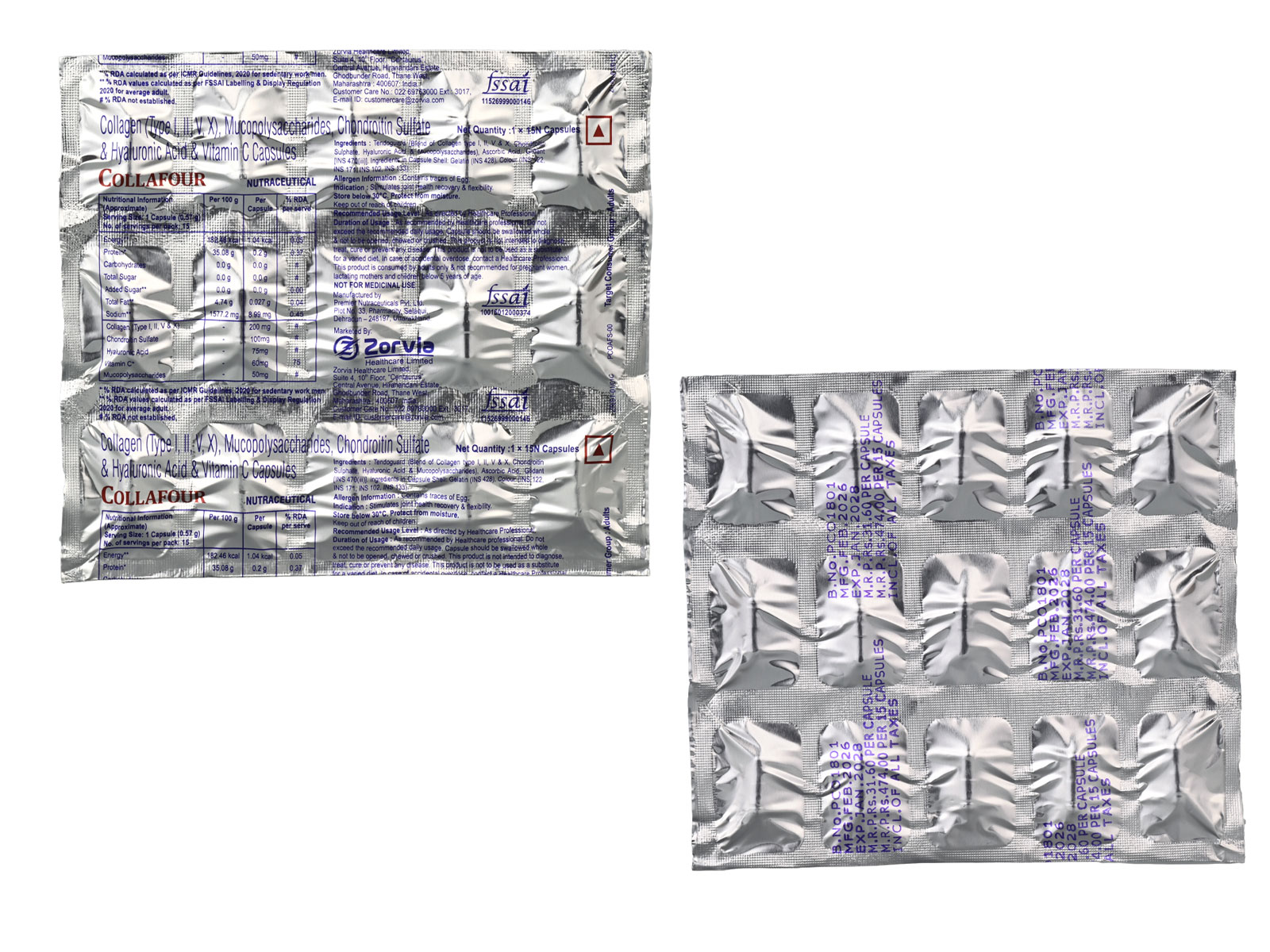
Net Quantity: 1 x 15 N Capsules
8.4 Storage and Handling Instructions
Store below 30°C. Protect from moisture.
Keep out of reach of children.
9.0 Patient Counselling Information
- It is NUTRACEUTICAL product.
- Not for medicinal use.
- This product is not intended to diagnose, treat, cure or prevent any disease.
- Not to exceed the stated recommended daily dose.
- Precaution: This Product is consumed by adults only and not recommended for pregnant women, lactating mothers and children below 5 years of age.
- Supportive therapy for cartilage and joint health.